

Towing is a huge part of a pickup’s working life, with almost three in four pickups having a tow bar fitted at three years old. We put the towing capabilities of the double cab Mitsubishi L200 to the test in this long-term update.
Mitsubishi L200: Towing Capacity
Unlike most modern pickups, the Mitsubishi L200 doesn’t have a 3.5-tonne towing capacity, which means it cannot tow a 3.5-tonne trailer even if it is empty. The towing capacity, instead, is rated at 3.1 tonnes for double cab models so customers would have to have their trailer down-plated to comply with the rules of the road.
Mitsubishi L200: Gross Train Weight
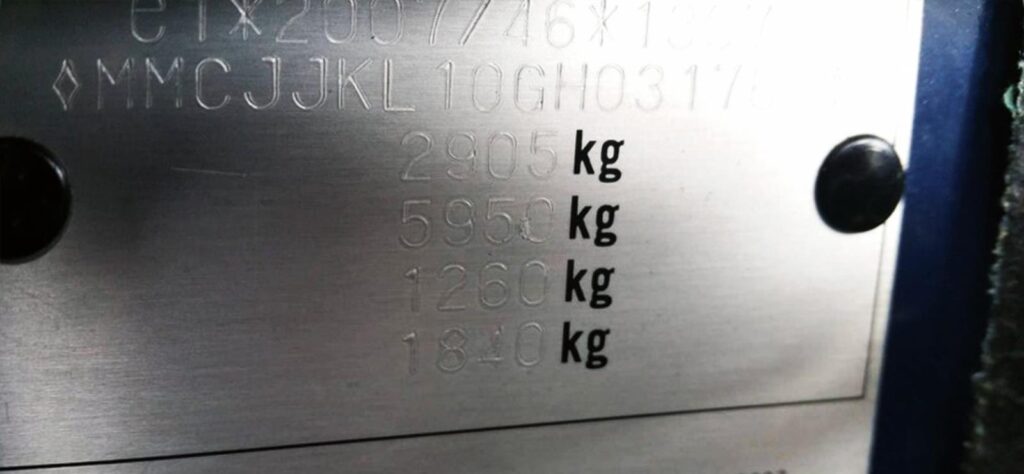
Most modern pickups can no longer carry the full payload and tow the full capacity at the same time. To work out exactly how much you can carry and tow at the same time, operators must open the bonnet (sometimes located on the driver or passenger door) and take a look at the weight plate.
The first figure is the gross vehicle weight (maximum weight of the unladen L200 plus all of its contents) and the second is the gross train weight, or gross combination mass (maximum weight of the unladen L200, trailer and all of their contents).
According to the weight plates, our L200 has a gross vehicle weight of 2,900kg and a gross train weight of 5,950kg, and we know from the spec sheets that the unladen weight is 1,850kg. Therefore, when towing the full 3.1 tonnes, you can have 1,000kg of payload (GTW minus the 3.1t trailer weight and 1,850kg kerb weight).
However, if you want to carry the maximum payload and are wondering how much weight you have left to tow, you simply deduct the gross vehicle weight (2,900kg) from the gross train weight (5,950kg), which leaves you with 3,050kg.
Mitsubishi L200: Towing Performance
Don’t be put off by the rather compact 2.4-litre engine; the Mitsubishi L200 Barbarian produces up to 181hp and 430Nm and is quick off the line even when towing the full load. The trailer felt very secure with minimal bounce, while the small turning circle meant it was easier to manoeuvre in tight spaces.
- Isuzu D-Max DL40 Commercial brings high-spec Extended Cab back for business users
- Foton Tunland pickup heading to the UK
- Horses meet horsepower as Mitsubishi L200 returns to Blenheim
- Isuzu D-Max 2.2 review: Making less noise about its capabilities
- MG badge finds another home on U9 electric pickup


- Driven: Nissan Navara N-Guard Review - 3 March 2020
- Great Wall Purchases GM’s Rayong Pickup Factory - 17 February 2020
- Hyundai Santa Cruz Pickup Due in 2020 - 16 February 2020