
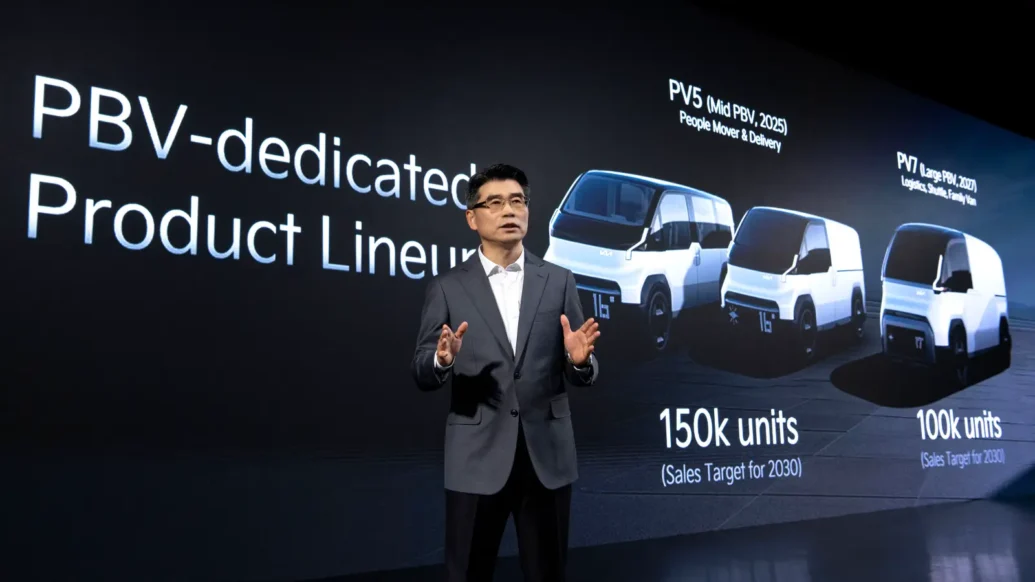
Kia outlined a comprehensive strategy at its 2024 CEO Investor Day, held in Seoul. It placed a strong emphasis on its Platform Beyond Vehicles (or van) range, confirmed new PBV models and launch windows, and targeted an ambitious annual sales figure of 250,000 units by 2030.
This strategic focus is part of Kia’s broader vision to evolve into a ‘Sustainable Mobility Solutions Provider’ and cement its position in the global electrification era.
While many of the forthcoming commercial vehicles had been announced earlier in the year, Kia confirmed two key PBV models, the PV5 and PV7, slated for release in 2025 and 2027, respectively. The PV5, a medium-sized van to rival a Ford E-Transit Custom, and the PV7, a larger E-Transit-sized model, are expected to contribute towards Kia’s growth, with global sales targets of 150,000 units for the PV5 and 100,000 units for the PV7.
The PBVs will be produced at Kia’s EVO Plant in Hwaseong , South Korea, utilising a flexible production system designed to adapt to market demand efficiently. Kia says this flexibility underscores its commitment to innovation and ability to respond proactively to the evolving mobility industry landscape.

Kia’s strategy for PBVs extends beyond traditional consumer markets, aiming to penetrate both Business-to-Business (B2B) and Business-to-Consumer (B2C) segments. The company plans to leverage the versatility and innovative features of its PBVs to create new sales demands, particularly in the B2B sector, which requires vehicles tailored for various business purposes. Additionally, Kia aims to stimulate B2C demand, further diversifying its market presence.
To support its ambitious goals, Kia has committed a substantial investment of KRW 38 trillion (£22.1 billion) by 2028, with KRW 15 trillion (£8.7 billion) allocated specifically for future business initiatives, including PBV development. This investment reflects Kia’s desire to secure a leading position in the rapidly evolving automotive industry, focusing on electrification, sustainability, and mobility solutions.
The strategic importance of PBVs in Kia’s business model is evident as the company seeks to navigate industry-wide uncertainties, counter the rise of competitive brands — particularly from China — and adapt to changing market dynamics.

- Isuzu D-Max DL40 Commercial brings high-spec Extended Cab back for business users - 26 September 2026
- Foton Tunland pickup heading to the UK - 22 September 2026
- Horses meet horsepower as Mitsubishi L200 returns to Blenheim - 22 September 2026