
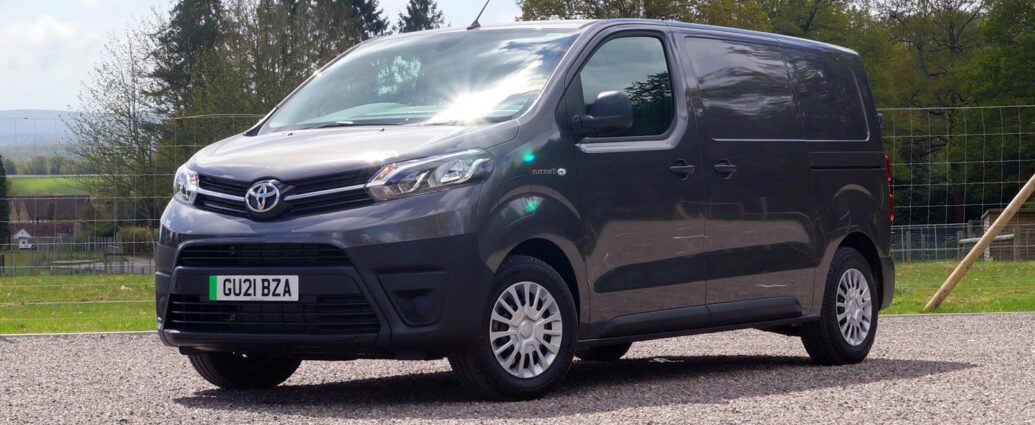
Toyota isn’t known for its vans, with the Prius hybrid car and tough Hilux pickup arguably defining the brand in the UK. It’s a varied brand though, with everything from incredible hot hatches, hydrogen-powered luxury cars and everyday SUVs in its range.
It should be no surprise that it got involved in the electric-powered light commercial vehicle market then, but it’s done so in partnership with Stellantis – the company that owns the likes of Peugeot, Citroen and Vauxhall.
That explains why the Proace looks just like a rebadged Peugeot Expert, Citroen Dispatch and Vauxhall Vivaro. It’s all the same underneath too, with a 136hp electric motor under the bonnet powered by a battery pack as large as 75kWh and promising a range of up to 205 miles.
At first glance, there’s little to differentiate the Toyota from better-known rivals, but is there more under the skin?

Toyota Proace Electric: Exterior
Toyota has immediately gone its own way and made the Proace Electric available in just one body size. It’s a mid-length body, measuring at 4,959mm long, with just one roof height.
That means the proportions look right, with no ungainly boxiness, although vans are rarely purchased for their cosmetic appeal. Still, with the horizontal ‘wing’ that runs across the front, encompassing the automatic headlights and Toyota badge, it’s an attractive if rather discreet package.
Creases running along the side are elegant and add depth to the visual appeal, while some plastic cladding creates a sense of ruggedness, but it’s ultimately as conventional as any other van – and it’s nearly identical to at least three other vans!
Toyota Proace Electric: Interior
It’s easy to get comfortable in the Proace, even if the driving position is ever so slightly offset, with lots of adjustment in the seat and steering wheel. That said, the seat doesn’t slide back that far, so taller driver’s might have a little bit of trouble.
In front of the driver sits a fairly uninspiring dashboard, but it’s neat enough. The gear lever has been replaced by a rocker switch to select forwards or reverse, which opens up the space a little and creates an airy sensation.
Buttons on the dashboard are kept to a minimum too, with a 7.0-inch infotainment screen taking on many of the controls. Quick shortcut buttons sit on either side, so it’s not too difficult to find the part of the system you’re after when driving.
That infotainment centre comes with a DAB radio and Bluetooth connectivity, as you would expect. Pleasingly, there’s also Android Auto and Apple CarPlay included, so you can ignore most of the van’s systems and simply use your smartphone’s systems that you’ll already be familiar with.

There’s just one problem with that; there’s a serious lack of USB ports in the cabin, and the one you’ll need has a tempting shelf by it to place your phone. That shelf is made of hard, shiny plastic and isn’t quite big enough for even a modestly sized smartphone. The result is that, at the first hint of robust acceleration or enthusiastic cornering, your expensive phone will be sent flying somewhere onto the floor. For the sake of ten pence on production costs, a grippy rubber mat in there would work wonders.
You’ll also find that it’s not quite as spacious as other vans, with little storage in the cabin when compared to something like a Ford Transit Custom.
But, small niggles and a somewhat bland experience aside, it’s a comfortable environment that will generally serve you well for both short stop-start hops as well as longer delivery runs.
Toyota Proace Electric: On the Road
There’s just 136hp available from the electric motor in the Proace Electric, but there’s instant torque available that does a great job of masking the relatively low power output. As with any electric vehicle, when you put your foot down there’s an immediate surge, leaving the Proace feeling eager and lively, unlike its traditionally powered rivals.
Motorway speeds (and beyond, if you’re in Germany) are easily reached, with little letup in push until you’re well into the 60mph area. Once at speed, it’ll sit there quite happily, the van being pleasingly quiet and effortlessly refined.
Country roads are dealt with equally as well, thanks to the battery pack being mounted low down, under the floor. That keeps the weight low, ensuring the Proace Electric remains stable with little body roll in corners. Some sharper steering would be nice, as it’s a little vague at times, but it’s no worse than you’ll find on many other similar vans.
The stubby nose and relatively upright windscreen makes for good visibility, especially around town, where the Proace is easy to navigate through busy roads. The mirrors are a tad small though, so care is needed in particularly tight areas, but rear parking sensors help in locating the end of the van.
Toyota Proace Electric: Electric Range and Charging
Our test model was fitted with the 75kWh battery pack, but there’s also a lower capacity 50kWh pack available. Officially, you can go for 205 miles with the larger pack, or 142 miles with the lower capacity option.
In reality, you’ll struggle to reach those figures, but that’s not unusual – think of electric range figures as being as wide of the mark as any fuel economy figures. More realistically, you should be able to hit 170 miles or so, if you drive reasonably carefully; our test showed we’d make it as far as 180 miles, but traffic was light and the weather was good. Hammer the accelerator and that will drop significantly, as it will if you find yourself cruising along motorways for more than a few miles.
Three driving modes work to help you maximise efficiency. Eco mode cuts power and torque and, with it, acceleration, but it does eke out some extra miles. Normal mode restricts power a little, and is ideally suited to urban and lightweight duties. Finally, Power mode unleashes all 136hp for more oomph, which will help make the Proace feel a little more alive when fully loaded.

It’s reckoned that the average van covers just 52 miles a day, so for those spending most of their time in urban areas there’s more than enough range for a full day’s work before needing to plug in and charge. At that point, your van will be out of action for a while, but it only takes 48 minutes to recharge from to 80% (as long as you can find a suitable rapid charger) which is enough to go for another 164 miles, at least officially.
You can charge the Proace Electric from a standard three-pin plug, but that will take a while; expect to be plugged in for more than 24 hours for a completely empty to completely full charge. A dedicated charger unit at home or depot will cut that down to around seven hours, which means the van will be fully charged every morning.
Toyota Proace Electric: Payload and Towing
Limiting the Proace Electric to just one body size limits capacities a little, but does ensure that you know what you’re getting. The choice is simple when there’s only one option.
At ever so slightly under five metres in length, the Proace Electric can take a load of up to 2,413mm in the cargo hold. There’s 1,636mm of width and 1,397mm of height to play with too, which is, as you might expect, all but identical to the cargo area you’ll find in the Vivaro, Dispatch or Expert. All told, there’s 5.3m3 available to fill which is, interestingly, exactly the same as that available in the diesel-powered versions.

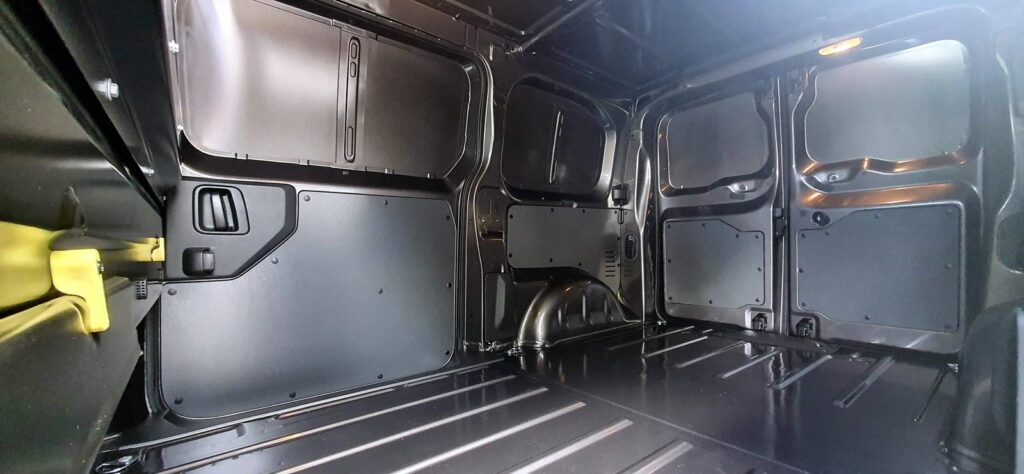

A load-through hatch allows for an unusually long (but also small) load to be slotted in under the passenger seat, but this area also houses the charging cables so might not be quite as useful as it first appears. Access to the load area is good, though, as there’s a pair of rear doors that open through 180 degrees, and a sliding door on each side of the van.
Ultimate payload capacity varies, with the 75kWh battery pack eating into the limit and leaving the Proace Electric with a tonne to play with. Cut costs (and range) and stick with the 50kWh model and that expands as far as 1,226kg.
Impressively, the Proace Electric is also rated to tow a tonne, something that’s unusual for an electric vehicle of any kind.
| Kerb weight (kg) | 2,201 | Load bay length (mm) | 2,413 |
| Gross vehicle weight (MAM) (kg) | 4,025 | Load bay width (mm) | 1,636 |
| Payload (kg) | 1,000 | Load bay height (mm) | 1,397 |
| Gross vehicle mass (kg) | 3,025 | Load bay capacity (m3) | 5.3 |
| Towing capacity braked (kg) | 1,000 | Towing capacity unbraked (kg) | 750 |
Toyota Proace Electric: Verdict
In a world where there are options on length, height, seats, power, trim and even drivetrains, the fact that Toyota has arrived with a single size model with just one trim level to choose is brave, but perhaps underlines that it knows its customers well.
Owner-operators and small fleet customers will appreciate the simplicity, and the resulting strong residual values will help to keep lease costs in check. For those purchasing outright, you’ll see more of your money back at resale time than you will with even premium brand models.
Still, it’ll cost more than a diesel model, so there must be other benefits. Cheap fuel in the form of electricity will keep running costs low, as will the lower maintenance requirements. Servicing is just once every two years or 20,000 miles, so you’ll rarely see the service department. There’ll be no charges for driving into city centres covered by low emission regulations, which could save some firms a fortune.

And then there’s Toyota’s party trick. There’s a three-year-warranty as standard, with a 60,000 mile limit. That sounds rather stingy, especially when its siblings at Citroen, Peugeot and Vauxhall extend that to 100,000 miles. However, keep to the service schedule and get your Proace Electric serviced at a Toyota centre and that warranty will be extended as far as 10 years. There’s still a mileage limit, but for those covering smaller distances in urban areas, there’s the reassurance of trouble free travel for a decade.
With prices starting from £34,630 plus VAT, and rising to £39,463 for the higher capacity battery model with rapid charger capability, it’s also reasonably good value. Don’t forget that the government’s plug-in van grant can also be applied.
Even without that, the Proace Electric would be our go-to electric van. At least for now, anyway. The market is evolving so quickly, with new models arriving, that it may not keep the crown for very long.
Model tested: Toyota Proace Electric Icon 75kWh 11kw OBC
| On the road price | £47,345 | CV on the road price | £39,463 |
| Reclaimable VAT | £7,882 | CV model price range | £34,640-£39463 |
- Isuzu D-Max DL40 Commercial brings high-spec Extended Cab back for business users
- Foton Tunland pickup heading to the UK
- Horses meet horsepower as Mitsubishi L200 returns to Blenheim

- Isuzu D-Max 2.2 review: Making less noise about its capabilities
- MG badge finds another home on U9 electric pickup


- Isuzu D-Max DL40 Commercial brings high-spec Extended Cab back for business users - 26 September 2026
- Foton Tunland pickup heading to the UK - 22 September 2026
- Horses meet horsepower as Mitsubishi L200 returns to Blenheim - 22 September 2026