
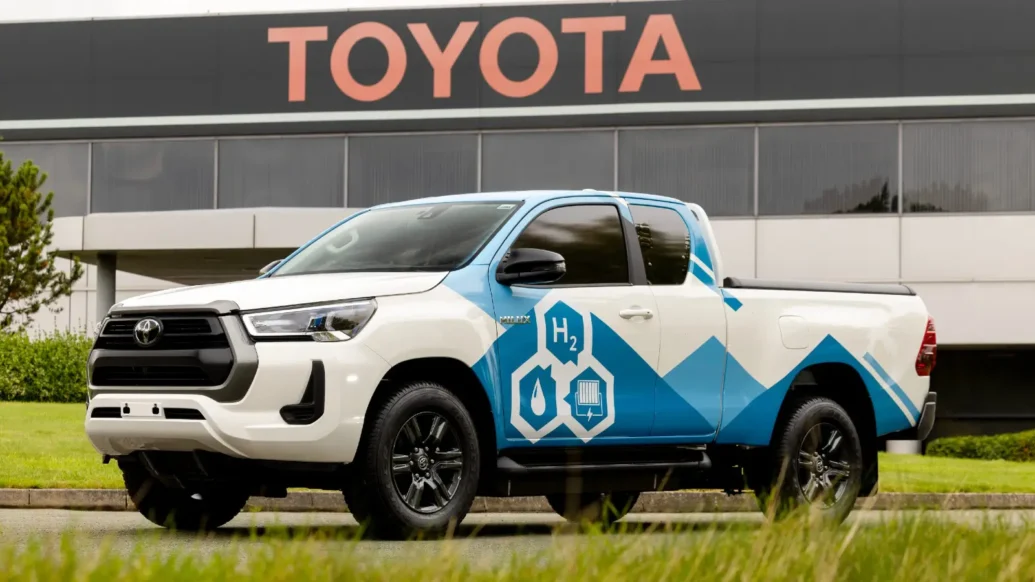
Toyota has revealed a ground-breaking hydrogen-fueled Hilux pickup built at its car plant in Burnaston, Derby.
The hydrogen Hilux prototype is powered by a fuel cell developed from the zero-emission drivetrain in the Toyota Mirai saloon. Three high-pressure tanks store hydrogen that is then delivered to a fuel cell, which uses chemical reactions to convert the hydrogen into electricity. This power is stored in a small battery pack and sent to an electric motor to drive the pickup.
The technology produces no emissions beyond pure water — which is clean enough to drink.

Taking advantage of the ladder frame chassis of the Hilux, the tanks have been placed between the chassis rails in the centre of the vehicle, with the battery pack positioned in the rear load deck to avoid any loss of cabin space.
The three tanks provide enough hydrogen for the Hilux to run for up to 365 miles, with refuelling taking less than 10 minutes at a suitable hydrogen filling station. However, the UK’s hydrogen infrastructure is currently lacking, with just three publicly accessible stations in the UK.
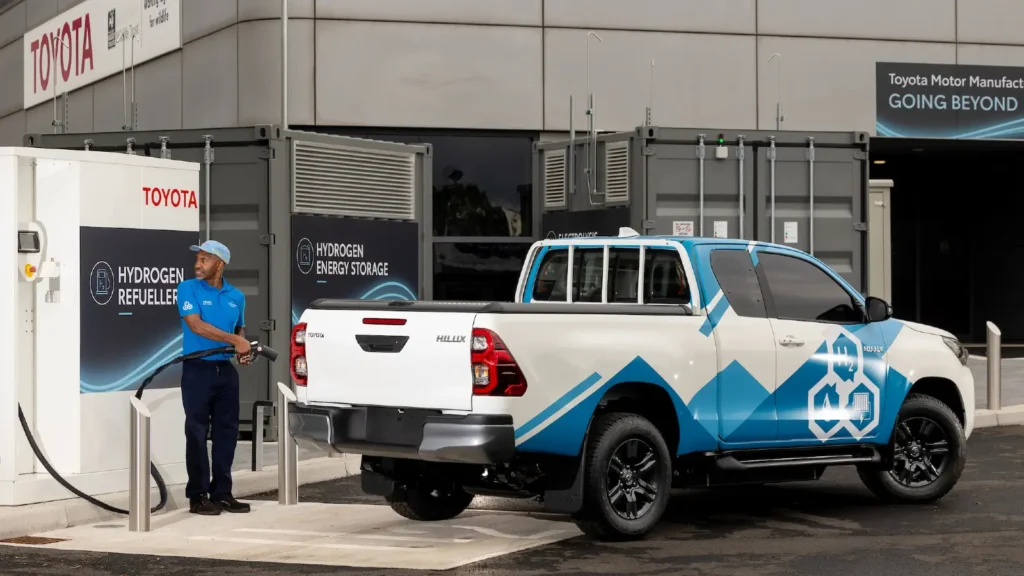
While just a prototype for now, the Hilux is a demonstration of the broad scope of Toyota’s multi-technology strategy for achieving carbon-free mobility, applying different powertrain solutions – hybrid electric, plug-in hybrid electric, battery electric and fuel cell electric – to suit different user needs and operating environments worldwide.
“The project team have accomplished an incredible job in a very short space of time, from creating the prototype build area to completion of the first vehicle,” commented Richard Kenworthy, Toyota Manufacturing UK (TMUK) managing director. “The UK Government funding has enabled us not only to develop a new vehicle in record time, but also to upskill our teams to work on hydrogen-related technologies, something we hope to build on in the future. This is a great vote of confidence in UK manufacturing and its potential to deliver carbon-free vehicles to meet future targets.”
Minister for Industry and Economic Security Nusrat Ghani added: “We have an amazing manufacturing sector here in the UK, and this is a great example. It’s fantastic to see Toyota reach another milestone on their journey to zero emissions here in Britain, and I congratulate the project team for their success on this cutting-edge development. This is a great vote of confidence in UK manufacturing and its potential to deliver carbon-free vehicles to meet future targets.”

Developed impressively quickly, the project only began in early 2022 with a feasibility study undertaken by TMUK and Toyota Motor Europe with consortium partners Ricardo, ETL, D2H Advanced Technologies and Thatcham Research. Funding was subsequently gained from the UK Government through the Advanced Propulsion Centre, a non-profit organisation supporting the development of cleaner technologies and new mobility concepts.
An intense design and development programme started in July 2022, with prototype construction beginning on 5 June this year. The first vehicle was completed three weeks later, the first of 10 that will be built by the end of this year.
Ian Constance, APC chief executive, commented: “The Toyota Hilux project is a fantastic example of collaborative R&D which has designed, integrated, and delivered a hydrogen fuel cell vehicle. UK Government funding through the Advanced Propulsion Centre (APC) anchors capability in R&D, which helps safeguard and creates new jobs for the future. It embeds the next generation of net-zero vehicles and technologies in the UK.
“The project consortium has made significant progress to deliver several vehicle demonstrators developed and built in the UK. Seeing the prototype hydrogen fuel cell Toyota Hilux global launch within a year of the start of the project is a clear demonstration of the capabilities and strengths of the UK’s automotive supply chain.”

- Mitsubishi L200 picks a fight with new Street Fighter movie - 17 September 2026
- Renault Niagara pickup revealed, but it’s only for Latin America - 10 September 2026
- Mitsubishi L200 Commercial swaps rear seats for van tax treatment - 10 September 2026