
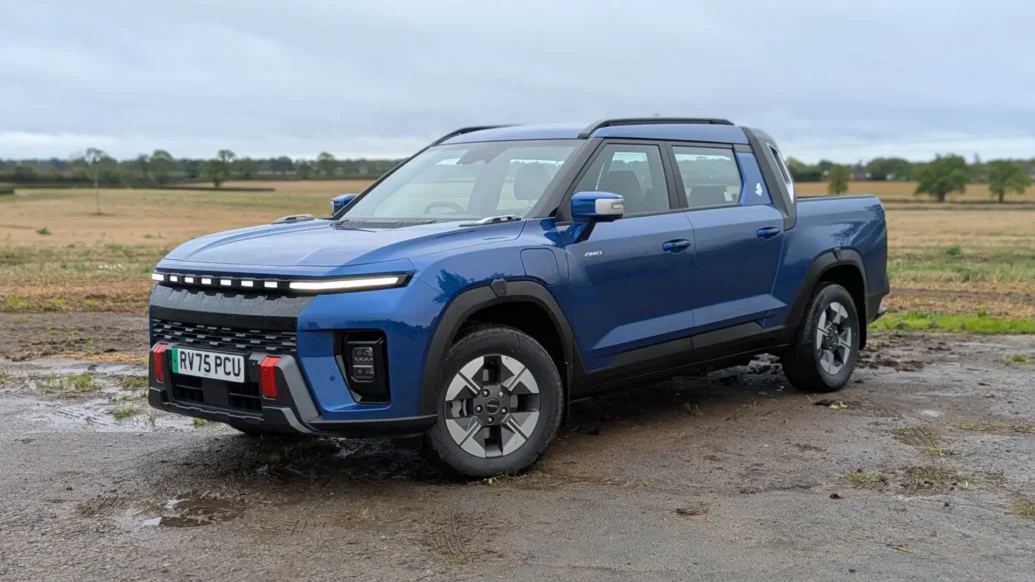
Electric pickups are a tough sell in the UK. Range anxiety, eye-watering prices and the challenge of matching diesel rivals for payload and towing have all conspired to keep zero-emission trucks firmly on the fringes. The KGM Musso EV doesn’t pretend to have solved every one of those problems, but it does approach them from a very different angle.
Rather than attempting to electrify a traditional one-tonne pickup wholesale, KGM has taken a more car-like route. The Musso EV is unrelated to the long-running diesel Musso and instead shares its underpinnings with the Torres SUV. That decision shapes everything about how it drives, what it can carry, and who it’s really for.
We’ve had an early drive in a near-production Musso EV on UK roads to see how that strategy plays out in the real world.

More SUV than workhorse
From the outside, the Musso EV looks every inch a modern double-cab pickup, with chunky cladding, a squared-off stance, and neat details such as integrated rear steps. Look a little closer, though, and its SUV origins become clearer. The proportions are tighter than a traditional pickup, with lesslength, a lower ride height, and a shorter load bed, reflecting its road-biased platform.

Inside, there’s no mistaking its roots. The cab is lifted almost wholesale from the Torres SUV, bringing with it a much more car-like layout than most pickups manage.
The dashboard is dominated by a pair of 12.3-inch screens — one for driver information and the other for infotainment and vehicle settings — framed by copper-coloured trim that gives the interior a surprisingly upmarket feel. Heated and ventilated seats, a heated steering wheel, dual-zone climate control, 360-degree cameras and vehicle-to-load capability were all fitted to our test vehicle, and they’re likely to remain when the Musso EV officially arrives here.
It’s not all great, though. KGM’s own infotainment system is slow to respond and overly complex, particularly when adjusting climate settings or dealing with overly intrusive driver assistance features. Thankfully, Apple CarPlay and Android Auto are both supported, and most drivers will likely default to using those instead.

Car-like drive
The Musso EV immediately feels different from a traditional pickup, and that’s largely a compliment. Power comes from twin electric motors producing 204hp and 339Nm of torque, delivering brisk performance for a commercial vehicle. With no load in the back, 0–62mph takes around eight seconds, with the instant response from the electric motor making it feel quicker than the numbers suggest.
More impressive than outright pace is the refinement. Noise insulation is good, wind and road noise are well suppressed at urban and rural speeds, and the ride quality is far more settled than you’d expect from a double-cab. Even unladen, the rear end avoids the skittishness that plagues leaf-sprung pickups, thanks to the Musso EV’s multi-link suspension.

That setup means the rear can feel a little bouncy over longer undulations when empty, but the overall impression is of a composed, confidence-inspiring vehicle that’s happy to be driven like a car rather than a truck.
Range and charging: strong by pickup standards
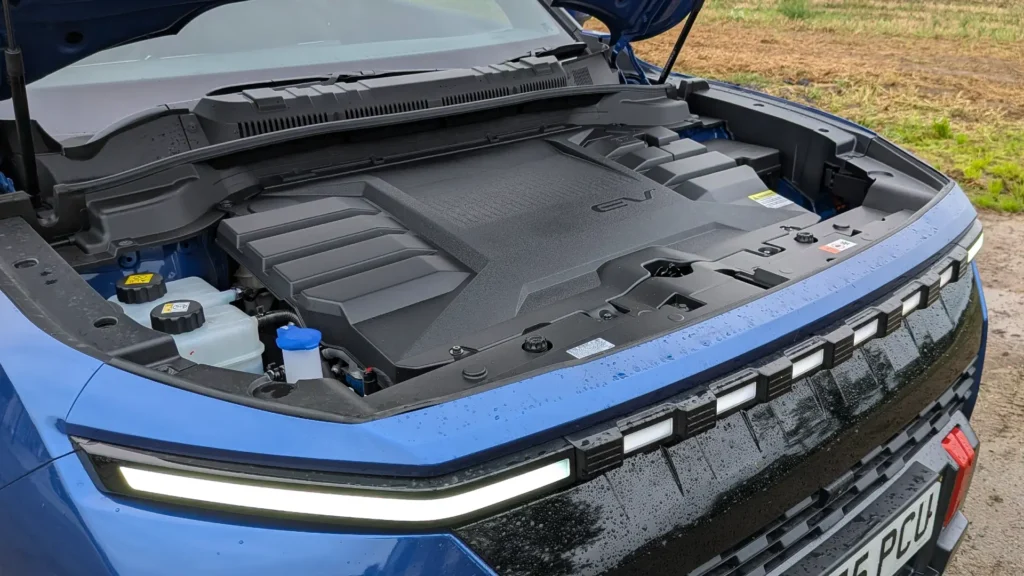
The Musso EV uses an 80.6kWh battery, larger than those in most rival electric pickups. The official range is expected to be around 230 miles, and over several hours of mixed driving, we saw the onboard computer report real-world efficiency of 2.6 miles per kWh. If that’s accurate, then we were heading for 209 miles from a full charge.
Charging performance is a strong point. With DC rapid charging at up to 120kW, a 10–80% top-up takes around 35–40 minutes, comfortably ahead of some rivals — it’s 50% quicker to charge than a Maxus T90 EV — and much more usable for drivers covering regular daily mileage.
Practicality and compromises
The Musso EV’s SUV-derived platform brings clear benefits on the road, but it also defines its biggest limitation. Payload is capped at 690kg, well below the one-tonne benchmark set by most diesel pickups, and enough to put it on the wrong side of HMRC’s definition for VAT reclaim.
Towing capacity is similarly reduced, with a braked limit of up to 2,300kg. That will be sufficient for lighter trailers and many leisure uses, but it won’t replace a diesel Ranger or D-Max for operators hauling heavy plant or livestock.

The load bed itself is smaller than most full-size pickups, too, measuring just over 1.3 metres in length, but it’s a well-finished space with a durable liner and thoughtfully integrated access steps.
Who is the KGM Musso EV for?
Those limitations mean the Musso EV won’t suit every pickup buyer. It’s aimed squarely at urban and suburban trades, fleets and lifestyle users who value refinement, range and low running costs over maximum carrying capacity.


Company car drivers will also note the Musso EV’s appeal in a post-tax-rule-change world. As a zero-emission vehicle, it attracts a very low Benefit-in-Kind rate of 3% for 2025/26, compared with 37% for a diesel double-cab, making it significantly cheaper to run than a traditional equivalent.
Pricing hasn’t been confirmed yet, but KGM is expected to undercut rival electric pickups by a considerable margin. If it lands around the £40,000 plus VAT mark that’s been widely suggested, the Musso EV could prove an attractive alternative for buyers who don’t need a traditional one-tonne workhorse.
KGM Musso EV: The early vrdict
The KGM Musso EV isn’t trying to be everything to everyone, and that’s precisely why it works. It’s quiet, comfortable, well-equipped and genuinely pleasant to drive, with real-world range that makes sense for daily use.

Its reduced payload and towing capacity will rule it out for many, but for the right buyer — particularly those operating on site in towns or cities, or for mixed business-and-leisure roles — it’s the most convincing electric pickup we’ve driven so far.
Sure, it’s not a replacement for a diesel workhorse, but it is a credible new direction for the segment.

- Toyota is turning the Corolla Cross into a compact hybrid pickup - 25 October 2026
- Tesla pulls the plug on UK right hand drive Cybertruck hopes - 24 October 2026
- BYD Shark first drive review: A different kind of working pickup - 22 October 2026