

The BYD Shark combines useful electric range, a comfortable ride and a spacious cabin. Its working limits will matter to some, but the business case deserves a closer look.
Not every pickup spends its life carrying a tonne of building materials or dragging a heavy trailer. Plenty carry tools between jobs, take a site manager to work, or combine business duties with family transport. For those buyers, the BYD Shark has rather more to offer than its modest payload might suggest.
BYD’s first UK pickup brings a large battery, plenty of equipment, and more power than anyone reasonably needs. More usefully, it rides well and promises enough electric range to cover a meaningful working day without petrol.
There are limits. A 790kg payload and 2,500kg towing capacity rule it out of some jobs, and the resulting VAT treatment complicates the price comparison. However, the Shark is cheap enough that the tax disadvantage matters less than it first appears.
It deserves consideration as a working pickup, provided its abilities match your work.
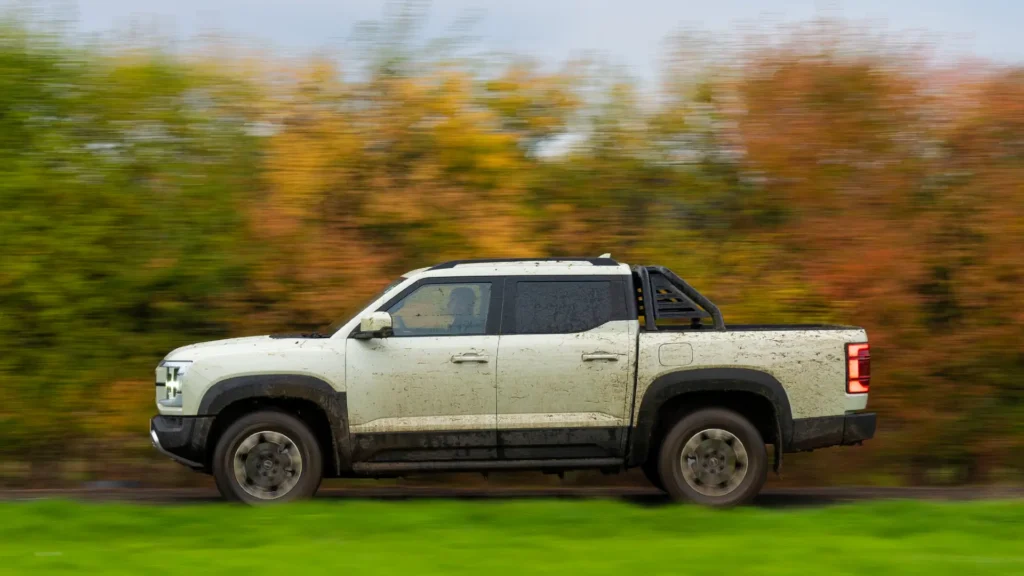
BYD Shark powertrain and performance
BYD has given its powertrain the preposterously hyperbolic name of ‘Super Hybrid DMO’. Behind the bombastic branding sits a 1.5-litre turbocharged petrol engine, two electric drive motors and a substantial 32.2kWh battery, all fitted within a ladder-frame chassis.
Combined output is 436hp and 650Nm of torque. To put that into perspective, Ford’s most powerful working Ranger makes 281hp, though it tops the Shark with 697Nm.
BYD quotes a 0–62mph time of 5.7 seconds. We recorded 6.2 seconds on a less-than-perfect surface, with a little moisture around, so we don’t doubt the power or performance figures. That’s also plenty quick enough for a 2.7-tonne double cab, especially as the Shark is refined enough that you can be travelling considerably faster than it feels.

The more useful benefit of that performance is the electric motors’ immediate response. There’s ample shove without waiting for an engine and gearbox to gather themselves, making the performance easy to use, and not just impressive against a stopwatch.
The petrol engine often runs as a generator, though it can also drive the front wheels directly when the system considers that more efficient. BYD quotes 55 miles of electric range, versus 26 miles in Ford’s Ranger PHEV, giving drivers with home or depot charging a credible chance to cover much of their routine mileage on electricity alone.
Driving the BYD Shark
Quietness is one of the Shark’s strongest qualities. Road and wind noise are well suppressed, and electric running removes much of the mechanical background noise familiar to diesel pickup drivers.
The petrol engine is less polished when called upon to work hard. It can sound coarse, with revs rising and falling without an obvious relationship to road speed. That behaviour is understandable given how the hybrid system operates, but it does occasionally interrupt the otherwise relaxed atmosphere.
With independent double-wishbone suspension at both ends, the Shark is probably the smoothest-riding pickup on sale. It’s not entirely eliminated the jiggle of an unladen truck — and we’ve yet to try the pickup with a load in the back — but it makes a convincing case for itself as something you could happily use every day.

There is decent balance, too. Take a corner enthusiastically and the Shark holds its line well, eventually easing into light understeer rather later than anything this size should. Its size and weight remain good reasons to leave a generous margin, but the chassis feels composed rather than overwhelmed by the performance.
The steering is less satisfying. Move away from the straight-ahead position and there’s a heavy, artificial-feeling resistance. Perhaps it’s intended to make the truck feel rugged and substantial, but the result is a little numb. If nothing else, it serves as a reminder that there are 2.7 tonnes to manage, even when the performance makes that easy to forget.
Taking the BYD Shark off-road
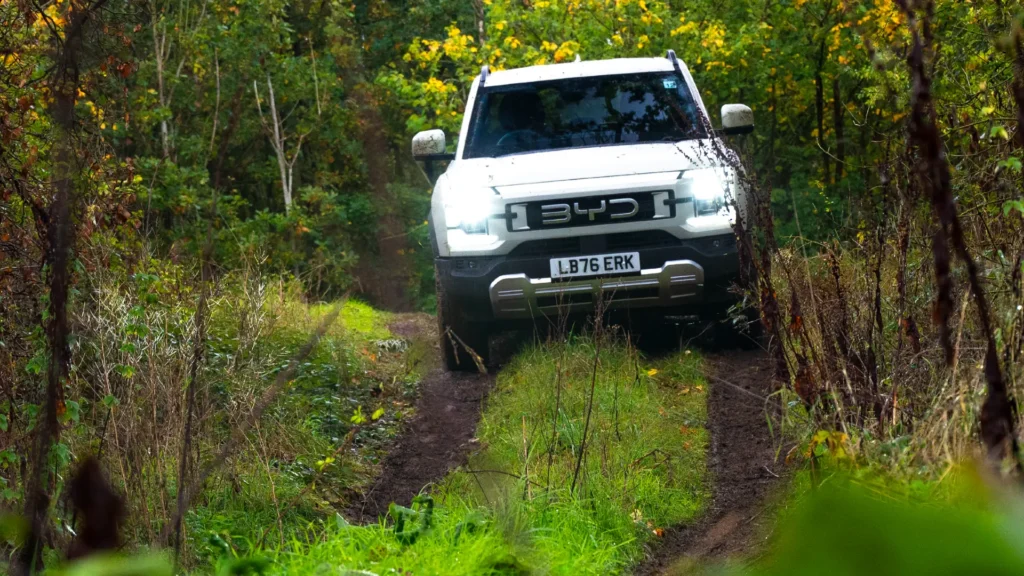
Our off-road experience wasn’t particularly demanding, although compacted wet grass can make life awkward for any vehicle. The Shark handled what it was asked, including wading through water deep enough to wash the front camera clean, some axle twists that lifted a wheel a few centimetres off the ground, and a muddy descent that put the hill descent control system to work.

The system offers selectable terrain modes — mud, sand, snow and mountain — but switching between them made little obvious difference on this course. They may contribute more when the terrain gets tougher, but this drive didn’t give us enough evidence to judge that, and nothing troubled the competitive 230mm ground clearance.
The separate electric motors supply the two axles without a conventional low-range transfer box. Nothing on the route exposed a problem with that arrangement, but this was a useful introduction to the Shark’s ability rather than a thorough assessment of its limits.
Cabin comfort and technology
The cabin feels really solid, with sturdy fittings and plenty of substantial grab handles. Those are useful features in a working pickup, where climbing aboard or steadying yourself over rough ground calls for something reassuringly robust.
Rear-seat accommodation is particularly good, as the lack of a propshaft means there’s a completely flat floor. Two adults can sit in the back comfortably, with a central seat for whoever gets the short straw, but it’s a more credible five-seat vehicle than pickups whose back seats feel like an occasional concession.

The 15.6-inch touchscreen dominates the dashboard, although the interface can be irritating. Some options are squeezed into a tiny strip along the bottom of a vast display, leaving you wondering why more of that space hasn’t been used to make the controls easier to hit. A large screen is only an advantage if the interface makes good use of it, and trying to stab at a small icon while wobbling around a field is frustrating.
A more successful detail is the ability to display Android Auto or Apple CarPlay mapping in the instrument panel ahead of the driver. Bringing navigation into the driver’s eyeline is useful, and feels like a better application of the technology than simply making the central screen bigger.

Equipment is generous, with heated and ventilated front seats, synthetic leather upholstery, a head-up display, a 12-speaker sound system and a 360-degree camera all included. It would have been nice to have a heated steering wheel too, but that’s absent from the spec list. Vehicle-to-load capability also allows electrical equipment to be powered from the truck, which could prove useful for tools or a weekend away.
The Shark has also earned a five-star Euro NCAP rating, with adaptive cruise control, blind-spot monitoring and a range of collision-avoidance systems included.
BYD Shark payload, practicality and towing
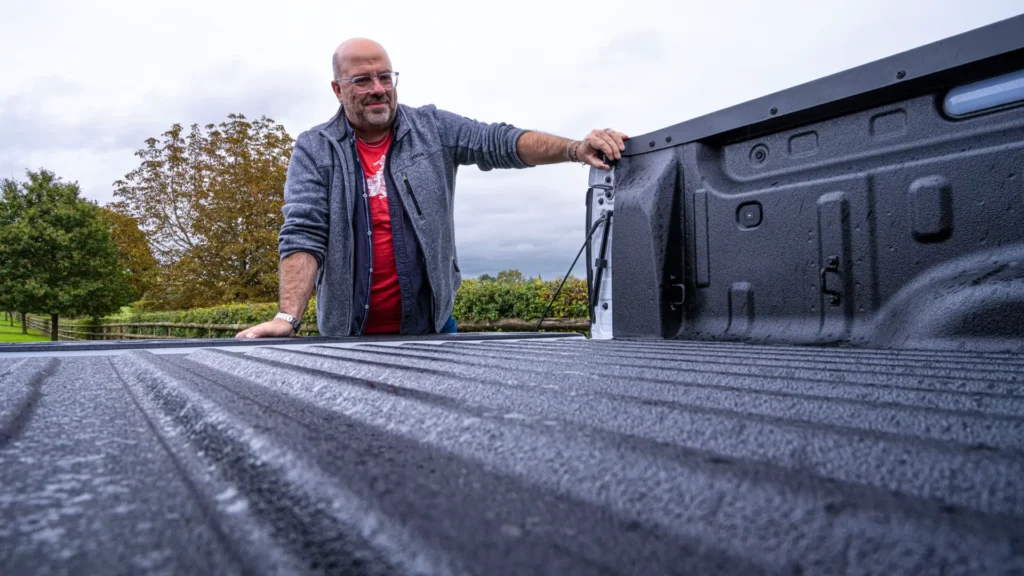
The business end of the Shark offers a quoted 1,200 litres of space — about the same as the Ranger’s 1,233 litres — but volume is only half the story.
The BYD Shark’s 790kg payload has to accommodate passengers and any additional equipment as well as cargo. Fill the cabin and add a hardtop, tools and other accessories, and the remaining allowance starts to look considerably less generous. A Ranger PHEV offers less performance and electric range, but can carry an extra 277 kilos.
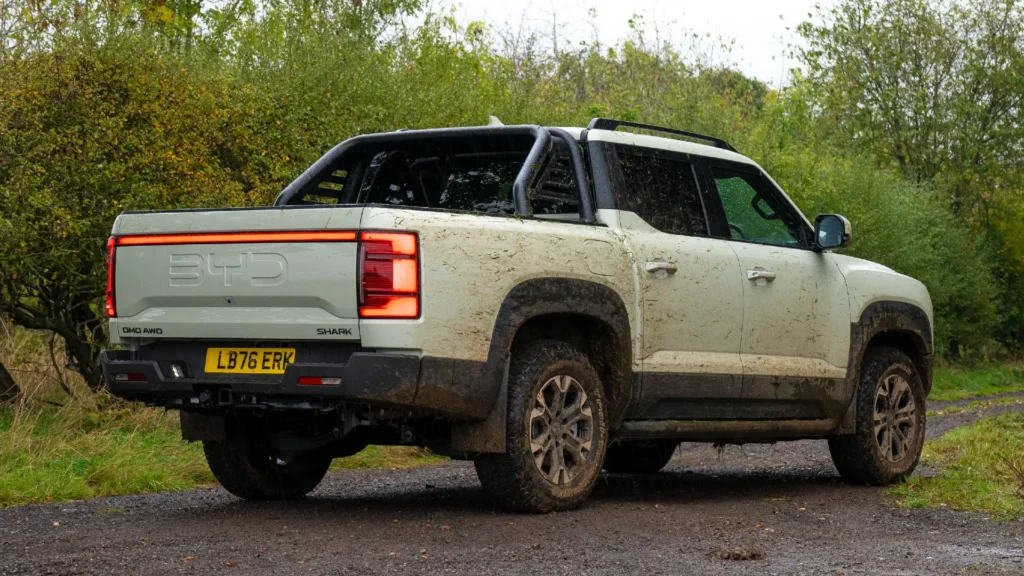
The tailgate includes a hidden step that slides out to make climbing into the back easier, which is a neat touch. It’s a manually operated tailgate, but it uses an electronic release button that didn’t respond reliably every time during our test. It’s a small frustration and doesn’t establish a long-term reliability problem, but it’s an unnecessary potential point of failure. A clunky handle might not be quite so neat, but it works.
Load-bed lights operated by a switch in the bed are a useful touch, as are the two weather-protected three-pin power sockets.
Maximum towing capacity is 2,500kg, a tonne below the Ranger PHEV’s 3,500kg limit. The BYD will cover plenty of lighter working and leisure tasks, but the Ford has a clear advantage when the loads get heavier.
Neither limit makes the Shark useless for work. They do mean you need to match it carefully to the job, rather than buying on the assumption that a large double cab can carry and tow much the same as its established rivals.
What does the BYD Shark cost to run?
The official 80.7mpg economy figure needs the usual plug-in hybrid context: it includes the benefit of starting with a charged battery. BYD’s quoted consumption with the battery at its minimum operating level is 29.4mpg, which is a more useful starting point for anyone expecting long days between plugs.
Charging is unusually flexible for a PHEV, too. There’s 11kW AC charging, but also support for 55kW rapid charging, with a claimed 30–80% charge taking 21 minutes — fine for a top-up on the road, but the costs will soon negate any benefit. A normal overnight charge will be the more relevant option for most owners.

Over a decidedly non-scientific 50-mile drive covering a mixture of roads, we averaged an impressive 52.2mpg. However, the Shark also consumed 13.7kWh of electricity, so the fuel figure tells only part of the story.
Using my own home electricity tariff, replacing that electricity would cost around £1.16 on a cheap overnight rate or £3.60 during the day (or on a standard home tariff). At 80p/kWh on a public rapid charger, it would cost £10.96.
For illustration, using petrol at £1.75 a litre, adding the electricity bill gives the same fuel cost per mile as a petrol vehicle returning roughly 45mpg, 35mpg or 21mpg respectively. Those figures show how much the charging arrangement matters.
Charge cheaply at home or work and there is a useful saving to be had. Rely on expensive public rapid charging and the case looks considerably weaker. The 52.2mpg headline needs the electricity bill beside it.
Price, VAT and business costs
The Shark costs £47,295 including VAT, with one generously equipped specification. Polar White is standard, while the other four paint choices — including a very bold Sunrise Orange — add £1,100. It’s backed by a six-year, 93,750-mile warranty, whichever comes first.
The Ranger Wildtrak PHEV is the Shark’s natural rival. It costs £46,256 excluding VAT, or £55,424 with VAT included.
With less than a tonne of payload, the Shark is treated as a car for VAT purposes, making it difficult to reclaim the tax, whereas reclaiming VAT on a Ranger is routine for suitable businesses. That distinction matters, but it doesn’t automatically make the Ford better value.

Assuming VAT recovery on the Ford, the Shark is around £1,000 more expensive. For buyers reclaiming neither vehicle’s VAT, the gap switches to being more than £8,000 in the BYD’s favour. For eligible businesses leasing a Shark for business and personal use, reclaiming 50% of the VAT on the monthly payments is generally allowable.
That puts a different complexion on the Shark’s business appeal. An owner-operator carrying tools and modest loads might prefer its longer electric range, ride comfort and equipment to cargo capacity they rarely use.
For company car drivers, tax rules also favour the BYD. Its 23g/km emissions and 55-mile electric range mean it faces a 10% benefit-in-kind rate for 2026/27, while the Ranger sits in the 16% band.
Capital allowances are a separate consideration, and the Shark’s lower emissions may offer faster write-down relief than the Ford.
Fundamentally, neither the VAT position nor the showroom price tells the whole tax story.
BYD Shark: Our first drive verdict
The Shark is a convincing pickup for buyers whose work fits within its limits. It has a spacious, solid cabin, generous equipment and probably the best ride in the UK pickup market. Its electric range could also make a useful difference to daily running costs for owners with cheap, dependable charging.
It’s not perfect, with the artificial steering, an occasionally irritating interface and our temperamental tailgate release leaving room for improvement.
The payload and towing limits are more fundamental. If the job needs a tonne in the back or a 3.5-tonne trailer, the Shark can’t do it.

However, that doesn’t make it merely a family SUV alternative with a load bed attached. For tradespeople carrying lighter loads, it’s a credible working choice. Its lower price largely offsets the purchase-VAT disadvantage against a Ranger PHEV, while lower company-car tax bills may strengthen its appeal further.
A diesel truck remains a sensible starting point for sustained heavy towing and long working days with little opportunity to charge, but BYD has built a pickup with different priorities. For buyers who share them, there is a sound case for the Shark.

- BYD Shark first drive review: A different kind of working pickup - 22 October 2026
-
 Is your electric pickup ready for remote work? A guide to mobile charging - 21 October 2026
- BYD Shark earns five-star Euro NCAP safety rating - 19 October 2026