

The arrival of the all-new second-generation Amarok is here, marking a significant shift in how Volkswagen produces its commercial vehicles, says Dave Humphreys. A technical collaboration sees the German marque team up with Ford to share development costs across their respective ranges. Volkswagen takes the technical lead on the small vans (Caddy and Tourneo Connect), with the Blue Oval handling the mid-size vans with Transit and the next Transporter and pickups, resulting in this Amarok sharing its mechanical underpinnings with the Ford Ranger.
Some Volkswagen purists may baulk at the prospect of it sharing DNA with another manufacturer, though this isn’t the first time that Volkswagen has done so for a pickup; some may recall the Volkswagen Taro that was a rebadged fifth-generation Toyota Hilux. Thankfully there’s more to the Amarok now than a Volkswagen badge slapped onto the front.

You won’t find many dimensional differences between the Amarok and the Ranger, but there’s plenty to set them apart visually. Where the Ranger gets C-shaped running lights, the Amarok utilises a horizontal design that emphasises the appearance of the grille.
The headlights and grille integrate into one section on lower-spec versions, with the bottom section of the bumper wearing a metallic finish. It looks good, though the PanAmericana and Aventura models get an X-design front end that looks more distinctive and is a more cohesive design. This insert is darker on the PanAmericana and more metallic on the Aventura.
Aside from the entry-level Amarok, which gets 17-inch wheels, most run on 18-inch rims. The Aventura leaves the factory with 20-inch wheels, giving it more on-road bias. That is reflected further in the design of the Sports Bar around the load bed and chrome detailing on the door handles and side steps.

Volkswagen Amarok: Cabin
We spent much of our time with the Amarok in the higher grade PanAmericana and Aventura models, but a brief spell driving the Style version off-road shows that all variants have an interior worthy of the Volkswagen badge and are unlikely to disappoint buyers that expect a certain standard.
Cabin architecture mimics that of its Ford stablemate, and for anyone upgrading from a first-gen Amarok, the big difference is in the digitalisation. As standard, there is an 8.0-inch multifunction display and a 10.1-inch touchscreen for the infotainment system, which runs a Volkswagen-skinned setup and is available with Apple CarPlay and Android Auto.

Further up the range, the digital instrument display upgrades to a 12.0-inch unit that looks impressive and has excellent graphics, including animations when selecting the different drive modes. Joining that is a 12.0-inch portrait-style touchscreen that’s very different from anything in the last Amarok. It retains some physical buttons along its base for quick access to things such as volume control and drive modes, but the lack of physical dials for the temperature adjustment seems like an oversight, requiring users to change it via the touchscreen.
Beneath the display is a wireless charger, which is usefully angled so that your phone is less likely to slide around and stop charging. Somewhat sensibly, Volkswagen specs both types of USB connection and a 12-volt power supply next to this too.
Credit must also go to Volkswagen for its front seats. Besides offering up to 10-way electrical adjustment, they’re supportive in all the right places and remain comfortable after several hours at the wheel. A modest stretch in overall length mainly helps those seated in the rear where both headroom and legroom are decent when in the outer two seats, though as is often the case, the middle seat is compromised for space, partly due to the rear of the centre console.
Volkswagen Amarok: On and off the road
The 10-speed automatic is quite impressive at keeping the engine spinning at an optimum speed for performance and efficiency. With 600Nm on tap from only 1,750rpm, there’s little need to stress the 3.0-litre diesel all that much in typical everyday driving. It gets up through the box quickly, and you’ll rarely see the tacho nudge beyond 2,000rpm so long as you show any hint of prudence with your right foot. It’s just as quick to drop three, four, or even five gears when you need to make a quick overtake or make progress more quickly.

What we weren’t so keen on was the automatic shifter itself. It’s the same as the Ford Ranger and has a very short distance between the various stops, meaning it’s pretty easy to put it into Park when you’re quickly trying for reverse during a three-point turn, for example. It may be something owners become accustomed to, but we think it could be better engineered. Drivers can also operate the gearbox manually, but not via paddles behind the steering wheel. Instead, there is an ‘M’ button on the shifter’s side by your thumb, with up and down buttons. This setup isn’t the most intuitive to use, and we ended up simply leaving it in its full auto mode.
The on-road performance is polished, and even though we didn’t have any weight in the load bed, the ride quality remained settled for the most part — only very uneven surfaces made the rear seem busy. You don’t experience much in the way of body roll through bends despite the sensation of sitting up relatively high. Steering is well-weighted and maintains a healthy connection to the front axle. However, we were more impressed that Volkswagen has stuck with physical buttons for the multifunction wheel rather than the dreadful haptic touch-sensitive ones in its current crop of passenger cars.
| Approach angle | 30° | Climbing angle limit | TBC |
| Departure angle | 26° | Ground clearance | 237 mm |
| Ramp angle limit | 21° | Wading depth | 800 mm |
Venturing into the dirt is a better way of sampling the various driving modes. Earlier, we mentioned the slick animation when choosing them, but this is also beneficial to those who aren’t as familiar with the appropriate transmission setting to use for the conditions at hand. Picking the mode also sets up the drivetrain accordingly, making it much more user-friendly. Tackling some medium-difficulty trails posed little trouble to the Amarok, which was the 2.0-litre engine for this purpose. Sure, the Goodyear Wrangler tyres helped with traction, but we noted little in the way of bottoming out or scraping the underbody, even with some sharp departure and break-over angles.

Volkswagen Amarok: Economy and Running Costs
An all-diesel range consisting of four and six-cylinder engines provides a decent spread of performance and efficiency depending on your needs. At the base of the range for the Euro 6 market is a 170hp 2.0-litre four-cylinder that produces 405Nm and is available only with the six-speed manual. A juiced-up version with 205hp and 500Nm is also available, and buyers can specify this version with the 10-speed automatic, which is decent to drive.

Volkswagen doesn’t currently get access to the 3.0-litre petrol V6 that Ford puts into the Ranger Raptor. Instead, the Amarok gets Ford’s 3.0-litre V6 diesel. With 240hp and 600Nm, it will be better suited for towing than the smaller capacity engine, even though both are rated to pull the same weight. We can’t speak much for running costs at present because Volkswagen is still in the process of homologation for the Amarok, so no fuel consumption or emissions data is available.
Volkswagen Amarok: Payload and Towing
The load bed of the Volkswagen Amarok in double car configuration measures 1,624mm in length and is 1,227mm between the wheel arches. That means it is large enough to accommodate a Euro pallet either sideways or lengthways. Usefully, three lashing eyes are fixed along either side of the bed with a load capacity of 400kg.
Higher-spec PanAmericana and Aventura models are equipped with an electrically retractable shutter cover for the load bed, which can be operated either via a button on the dashboard or via the key fob once the vehicle is parked.

The maximum payload for the Amarok increases from the predecessor’s 1,000kg to 1,190kg, which is good news from a taxation perspective. We’re also pleased to report that the tailgate is noticeably lighter than before. If you need to carry anything on the roof, it’s rated for 85kg on the move and up to 350kg when stationary, making it suitable for a roof tent if you’re so inclined. When it comes to towing, any engine you choose is rated to pull up to 3,500kg.
| Kerb weight | 2,184-2,540 kg | Load bay length | 1,624 mm |
| Gross vehicle weight (MAM) | 6,500 kg | Load bay width | 1,227 mm |
| Payload | 1,190 kg | Load bay height | 529 mm |
| Gross vehicle mass | 3,500 kg | Liftover height | 827 mm |
| Towing capacity (unbraked) | 750 kg | Towing capacity (unbraked) | 3,500 kg |

Volkswagen Amarok: Verdict
Dyed-in-the-wool Volkswagen purists might not be all too pleased with the involvement of Ford in the new Amarok, but it does nothing to take away from it — if anything, it has made it much better than its predecessor. All that expected interior quality is matched with a driving experience that demonstrates a high degree of competence.
Model tested: Volkswagen Amarok 3.0 TDI Aventura
| Basic price | £45,000 | On the road inc VAT | £54,000 |
| VAT | £9,000 | Model range exc VAT | £40,000-£46,000 |
- Mitsubishi L200 picks a fight with new Street Fighter movie
- Renault Niagara pickup revealed, but it’s only for Latin America

- Mitsubishi L200 Commercial swaps rear seats for van tax treatment
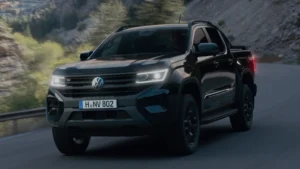
- Volkswagen launches blacked-out Amarok Dark Label pickup
- Pickup market plunges to lowest level since Covid lockdown

- Mobilize Bento first drive: Micro-van thinking for the last mile - 8 December 2025
- Ranger revised: Updated Ford Ranger for 2026 - 26 November 2025
- Isuzu strengthens trade ties with Nick Knowles ambassador deal - 25 November 2025