
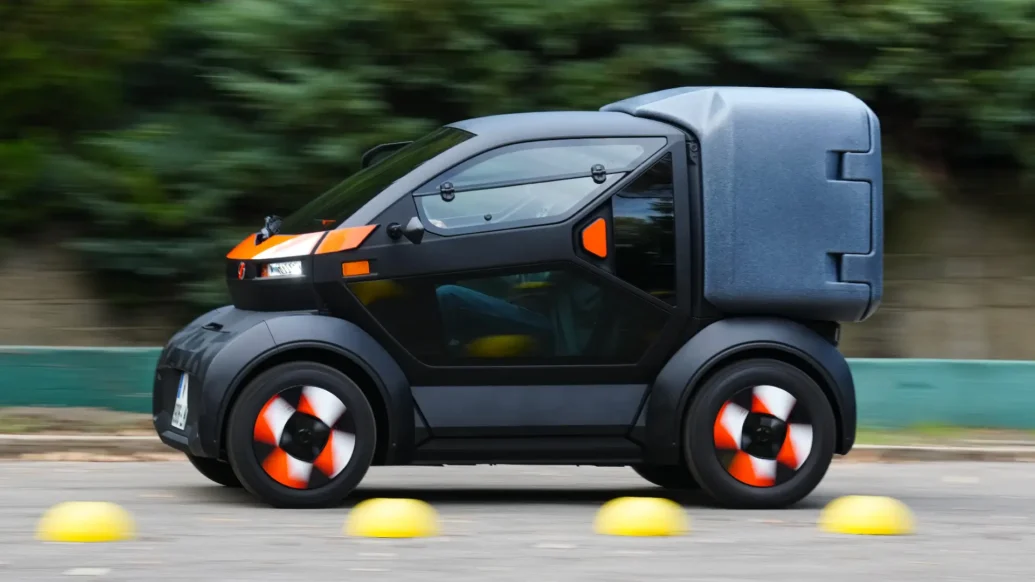
Urban mobility is one of those phrases that risks meaning everything and nothing at once. For van operators working in town and city centres, however, the underlying problem is very real: congestion is getting worse, emissions rules are tightening, and the cost of running even the smallest ‘proper’ van continues to rise. Into that space steps the Mobilize Bento.
The Bento is a vehicle that sits well outside the traditional light commercial vehicle box. It’s built to L7e quadricycle regulations, so technically it isn’t a van. Measuring just 2.54 metres long, it’s also not being pitched as a van replacement, but as a last-mile tool for situations where even a compact electric van feels oversized.
This is the first vehicle from Mobilize, Renault Group’s mobility-focused division better known for charging services and fleet solutions. The Bento is closely related to the Mobilize Duo passenger quadricycle, but swaps the rear seat area for a large external cargo box, creating what the brand describes as a “micro-van”.
The result is something that sits somewhere between an e-scooter with weather protection and a conventional small van like the Dacia Spring Cargo or Citroen e-C3 Van.

First impressions: Tiny footprint, big intent
There’s no mistaking the Bento for anything else on the road. With its narrow stance, exposed wheels, and dramatic scissor doors, it looks closer to a concept vehicle than a working tool. Yet there’s a seriousness to its intent that becomes clearer once you start using it in traffic.
At 1.3 metres wide, the Bento can exploit gaps that would stop a conventional van dead, and its turning circle and manoeuvrability make dense urban driving genuinely stress-free. Parking, too, is a non-issue: two Bentos will fit into a single standard car bay, and nose-in kerbside stops are easy.
The scissor doors aren’t a gimmick either. In tight loading zones or narrow streets, they allow the driver to get in and out without needing side clearance, something that will matter to couriers and service engineers working in crowded areas.

On the road: Better than you’d expect
Power comes from a 21hp electric motor paired with a 10.3kWh battery. On paper, that sounds wholly inadequate, but the Bento weighs just over 500kg, and in an urban environment, it feels surprisingly alert.
Throttle response is sharp at low speeds, which is exactly what you want when darting through traffic or pulling into tight gaps. It’ll reach up to 50mph, giving it a significant advantage over rivals like the Citroen Ami Cargo, which is capped at 28mph. That extra headroom makes it viable for short stints on faster urban roads or ring roads, even if it’s clearly happiest below 40mph.
Steering assistance is standard and well judged. Rather than being overly light, there’s enough weight and feedback to give confidence when threading through traffic, although tiny mirrors mean it can be tricky to keep on top of what’s going on around you. Regenerative braking is tuned for stop-start city use, and while there’s no true one-pedal mode, the calibration feels natural in slow-moving conditions.

Ride quality is better than expected for a quadricycle. Sharp bumps still make themselves known, but over broken Tarmac and cobbles, the Bento remains composed enough to be usable over a full shift. Noise insulation is minimal, however, and the plastic doors with flip-up window panels do little to isolate the driver from the outside world.
Mobilize is targeting an urban range of up to 100 miles. In real-world use, 70–80 miles feels more realistic, which should still be ample for a full day, or more, of city-centre work.
Interior: Clever layout, limited storage
The Bento’s cabin is unusual, even by quadricycle standards. The driver sits centrally, a layout that avoids right-hand-drive build complexity while also delivering excellent forward visibility. The largely transparent doors help with judging tight spaces, though rearward visibility is poor thanks to thick pillars and the external cargo box.

The dashboard is basic but functional, with a small digital display for speed, range and battery state, flanked by physical buttons for key functions. It’s more user-friendly than the Ami Cargo’s minimal setup and feels designed for daily work use rather than novelty value.
Storage, however, is a weak point. There are no door bins, no cupholders and no dash trays. Aside from a phone mount and a small seat-back net, there’s nowhere to put paperwork, drinks or tools inside the cabin. For professional users, that’s perhaps too much of a compromise.
Seat comfort is better than expected, with wipe-clean recycled upholstery and reasonable support, but headroom is tight. Drivers over six feet tall will struggle.

Payload: Limited, but very specific
Calling the Bento practical depends entirely on the job in question. Payload is capped at 80kg. Really. That’s split between 60kg in the rear box and 20kg in the cabin area behind the seat, and immediately rules out many traditional van tasks.
What the rear box does offer is 649 litres of space for your cargo. Measuring roughly 124cm by 81cm by 77cm, it’s broad, deep and kept separate from the driver, making it suitable for parcels, food deliveries, small tools or specialist equipment. The rear doors open wide for easy access, and Mobilize says the box can be customised with racking, refrigeration or bespoke inserts.
In comparison, the Ami Cargo has a total payload of 140kg but just 400 litres of storage space. A Dacia Spring offers around 1,000 litres of space, but at 3.7m, it’s nearly 50% longer than the Mobilize Bento.

Security is a concern, though. The plastic construction and simple latch mechanism don’t inspire much confidence in high-risk areas, and operators would need to think carefully about what they carry and where they park.
Costs and fleet appeal
Pricing for the UK hasn’t been finalised, but Mobilize is indicating a figure below £10,000. That’s nearly £2,000 more than an Ami Cargo, but still cheaper than other quadricycles such as the Microlino or the Silence S04. It’s also £6,500 less than the Dacia Spring Cargo, but the Spring is bigger, quicker and offers a substantially higher payload.

The specification is sparse, but a driver’s airbag is standard — unique in this class — along with a heated windscreen, keyless entry, and USB-C charging. Everything else is an option, from the dash-mounted air conditioning unit and heated seat to rear parking sensors, a Bluetooth kit and “comfort seats with premium upholstery”.
Where the Bento makes sense for fleets is in its connected services. App-based access, geofencing and remote charge management are standard, and the battery will come with an eight-year, 50,000-mile warranty.

Mobilize Bento verdict: Niche, but not pointless
The Mobilize Bento won’t replace a Renault Kangoo or Toyota Proace City, and it isn’t trying to. What it offers is a credible alternative for businesses operating entirely within dense urban environments, where space, emissions and running costs matter more than payload.
For the right operator — last-mile couriers, city-centre service teams, or businesses replacing e-scooters and mopeds — it’s a surprisingly coherent solution, even allowing for some security concerns. For everyone else, it’s a fascinating glimpse of how fragmented the future of urban commercial transport may become.

- Mobilize Bento first drive: Micro-van thinking for the last mile - 8 December 2025
- Ranger revised: Updated Ford Ranger for 2026 - 26 November 2025
- Isuzu strengthens trade ties with Nick Knowles ambassador deal - 25 November 2025