

The Isuzu D-Max has always been a dependable workhorse, known for its durability and capability. But in 2025, where pickups need to double as family transport and lifestyle vehicles, Isuzu has to keep the D-Max fresh against newer competition.
It’s not even been two years since the D-Max last had a minor touch-up, and now there’s a second facelift to keep the pickup relevant. This latest update brings subtle design tweaks, a new Rough Terrain mode for better off-road traction, and upgrades to safety and infotainment. Yet underneath, it remains the same solid, no-nonsense truck that’s built a loyal following.
With rivals like the Ford Ranger, Volkswagen Amarok, and Toyota Hilux stepping up their game, can the D-Max still carve out its niche?

Tough, capable, and updated
The fundamentals of the 2025 Isuzu D-Max haven’t changed. The same 1.9-litre diesel engine carries over, offering 164hp and 360Nm of torque through either a six-speed manual or an optional six-speed automatic.
There are a few visual tweaks to keep things fresh — a very slightly revised grille, new headlights, and a lightly reshaped bonnet — but the big changes are more than skin deep. A Rough Terrain mode has been added, which tweaks the traction control to help in low-grip situations, and the safety systems have been upgraded with a wider field of view and better pedestrian detection.
Inside, the infotainment system has been overhauled, with an 8.0-inch screen as standard across most of the range and a 9.0-inch version in this V-Cross trim, both now offering wireless Apple CarPlay and Android Auto.

Driving the 2025 Isuzu D-Max
The D-Max is more refined than ever, but it’s still very much a pickup. The ride is improved over older models, with less body shake and a slightly softer edge to its suspension, but it can’t match the comfort of the latest Ranger or Amarok. It feels bouncy when unladen and still sends the occasional jolt through the cabin over sharp potholes.
The electric power steering is light and accurate enough for everyday use, though it lacks the precision of its best rivals. There’s a vagueness on the straight-ahead, and mid-corner bumps can unsettle it slightly. That said, the turning circle is better than most — at 12.5 metres, it’s tighter than a Ranger’s, making it easier to manoeuvre in town or on-site.
The engine gets the job done but doesn’t feel particularly lively. It pulls well enough at low speeds, but when overtaking or climbing hills, it has to work hard, and you’ll know about it — the diesel clatter is ever-present under acceleration. The manual gearbox is functional but has a very short first gear, so you’ll find yourself shifting up almost immediately, but that’s great if you’re pulling something particularly heavy. The automatic, while smooth, does hesitate before kicking down.

Off-road prowess
Where the D-Max really shines is off-road. The Rough Terrain mode is a useful addition, helping to prevent wheelspin on slippery inclines, and the rear differential lock (standard from DL20 upwards) adds extra traction when things get really tough. A wading depth of 800mm, solid underbody protection, and plenty of suspension articulation mean it’ll handle rough terrain with ease. There are more extreme models, such as the D-Max Arctic Trucks AT35, but for most people, it’s more than capable.
How capable? We took it through a boggy, wet, slippery off-road course that would challenge all but the most capable off-roaders and sailed through every section without too much difficulty. Sloppy, deep mud on steep downhill segments had the hill descent control working overtime, and the new Rough Terrain mode still left the D-Max sliding uphills, but it made it through everything we could throw at it. And I’m not 100% confident that every pickup out there would have managed the same.

Interior and comfort
Inside, the D-Max is a functional but pleasant place to be. The design is simple, but the materials are solid, and everything feels built to last. The V-Cross trim brings more soft-touch elements and a larger touchscreen, but even the lower trims now have a decent infotainment system.
The driving position is good, with lumbar support as standard, but some (including me) might wish for a steering column that extends further. Visibility is excellent, helped by large mirrors and slim A-pillars, while a reversing camera is now standard across the range. Higher trims add parking sensors and front cameras for extra assistance.
The rear seats in Double Cab models are spacious enough for adults, though the seat backs are fairly upright. The Extended Cab is more of a compromise, with occasional-use rear seats, while the Single Cab prioritises cargo space over passenger room. Storage is well thought out, with two gloveboxes, a cubby on the dash, and pop-out cupholders.

Practicality and load space
Payload remains a strong point for the D-Max, with all versions capable of carrying over 1,000kg. The Single Cab offers the most cargo space at 2,290mm long, but the Double Cab bed’s 1,520mm puts it at the shorter end of the market. Every 4×4 model can tow 3,500kg, though the 2WD Single Cab tops out at 2,500kg.
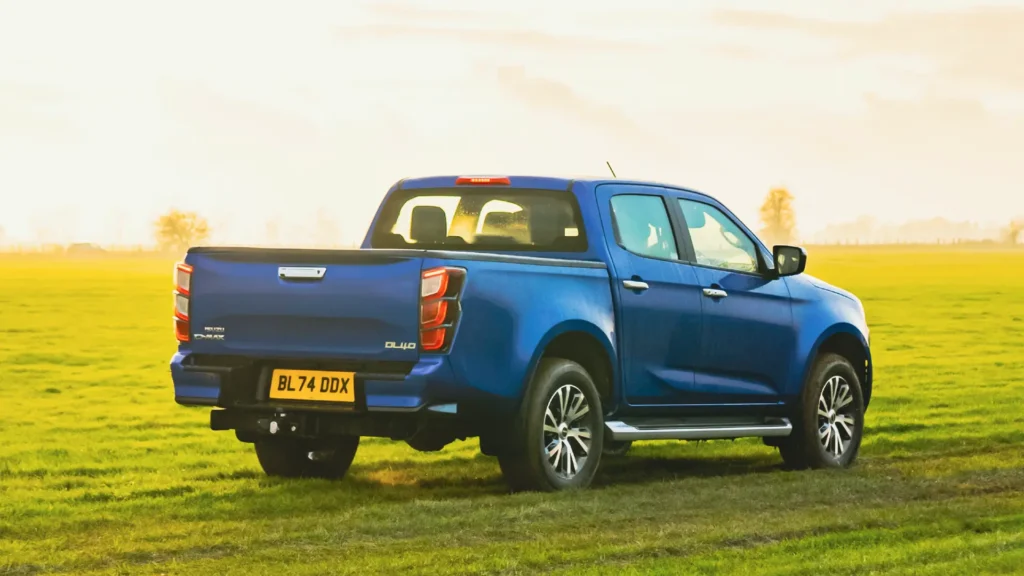
The tailgate has been redesigned with a built-in damper, meaning it no longer slams down when opened and is much lighter to close, and there’s a step integrated into the rear bumper for easier access to the load bed. It’s a thoughtful update.
A wide range of accessories is available, from hard tops and bed liners to roof bars and tow kits, making it easy to tailor the D-Max to specific needs. Splash out, and you could even recreate the seemingly unstoppable Mudmaster version.
Running costs and value
With fuel economy figures of up to 33.6mpg for manual models and 31.4mpg for automatics, the D-Max isn’t the thirstiest pickup out there, but it’s also not the most efficient. I’d give you real-world figures, but the terrible weather conditions and lengthy off-roading mean the numbers aren’t representative of everyday use.
It does, however, remain one of the best in terms of overall value. Prices start from £27,495 (ex. VAT) for the Utility Single Cab, with double cabs starting from £31,595. Our high-spec V-Cross reaches £39,995 before options. The warranty is another strong point — five years or 125,000 miles, plus five years of roadside assistance.

One thing to consider is the upcoming tax changes. From April 2025, double-cab pickups will be subject to car-like Benefit-in-Kind rates rather than the fixed LCV rate. That could make single-cab models more appealing to business users.
Isuzu D-Max 2025 verdict
The Isuzu D-Max continues to be a tough, dependable workhorse with just enough refinement to make it a credible daily driver. The latest update refines the pickup a little further and improves its capabilities slightly, but it’s still not as polished or powerful as a Ranger nor as upmarket as an Amarok. It makes up for some of that with reliability, practicality, and strong off-road ability.

If you need a pickup that will take a beating and keep going, the D-Max remains a solid choice. It’s not the most sophisticated, and the engine could do with more grunt, but it offers good value, a generous warranty, and a rugged charm that keeps its loyal fanbase coming back for more.
Model tested: Isuzu D-Max V-Cross Double Cab Auto
Professional Pickup Rating: ★★★☆☆

- Isuzu D-Max DL40 Commercial brings high-spec Extended Cab back for business users - 26 September 2026
- Foton Tunland pickup heading to the UK - 22 September 2026
- Horses meet horsepower as Mitsubishi L200 returns to Blenheim - 22 September 2026