
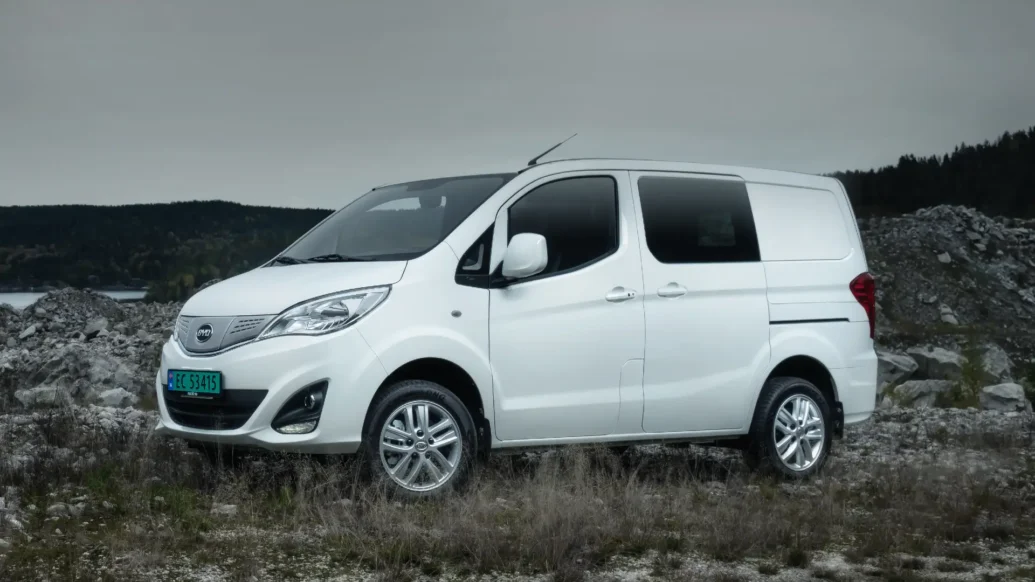
BYD is preparing to introduce limited quantities of its compact ETP 3 electric van to the UK, marking a cautious first step into the British light commercial vehicle sector. While the brand has become one of the UK’s fastest-growing passenger car manufacturers, its commercial vehicle presence has so far been largely associated with buses, where BYD products – particularly double-deckers – have gained meaningful fleet penetration.
Sources close to the plan suggest BYD will use the ETP 3 as a low-volume entry model ahead of a broader European commercial strategy. More significant announcements are anticipated at the IAA Transportation show in Hanover, where the manufacturer is widely expected to outline plans for larger vans targeting the highly competitive 3.5-tonne segment.
BYD ETP 3 cargo and payload
The BYD ETP 3 is differentiated by its unusual dimensions. Measuring just 4,460mm in length, the van is shorter than many familiar compact LCV rivals. However, its 2,725mm wheelbase is comparatively long for the class, a configuration that helps liberate a surprisingly generous 3.5m³ of cargo volume.
This places the ETP 3 up against established compact vans such as the Renault Kangoo E-Tech and Citroen e-Berlingo, at least in terms of outright load capacity. Despite the shorter overall body, the BYD’s packaging efficiency allows it to match, and in some cases exceed, the load volumes offered by those more recognisable nameplates.
Payload is similarly competitive. With a quoted 780kg payload, the ETP 3 sits squarely within expectations for a two-seat compact electric van, offering sufficient carrying ability for typical urban and last-mile duties.
The ETP 3 adopts a straightforward two-seat configuration. At the rear, a top-hinged tailgate provides wide-aperture access to the load area, while sliding doors on both sides improve flexibility.
One of the ETP 3’s more distinctive traits is its 1,720mm width, making it noticeably narrower than most mainstream competitors. Combined with an 11.5-metre turning circle, this slimmer footprint should suit congested urban environments where manoeuvrability is a priority.

Electric powertrain, range & charging
Power is supplied by a 44.9kWh battery driving an electric motor rated at 136hp and 180Nm of torque. That’s enough to give the BYD ETP 3 a WLTP combined electric range of around 171 miles.
As with all electric vans, real-world results will vary depending on payload, temperature, and driving conditions, but the ETP 3’s range sits below some key rivals that now push well beyond the 200-mile mark.
The trade-off for the smaller battery pack is charging speed. BYD claims the ETP 3 can achieve a full charge from zero in roughly one hour using DC fast charging, with a 20–100% session taking approximately 30 minutes under ideal conditions.
BYD ETP 3 pricing and availability
Professional Van understands that the BYD ETP 3 will start from approximately £25,000 plus VAT. That places it broadly in line with other compact electric vans, though final specifications, equipment levels, and supply volumes will ultimately determine its competitiveness in the UK market.

- Isuzu D-Max DL40 Commercial brings high-spec Extended Cab back for business users - 26 September 2026
- Foton Tunland pickup heading to the UK - 22 September 2026
- Horses meet horsepower as Mitsubishi L200 returns to Blenheim - 22 September 2026