
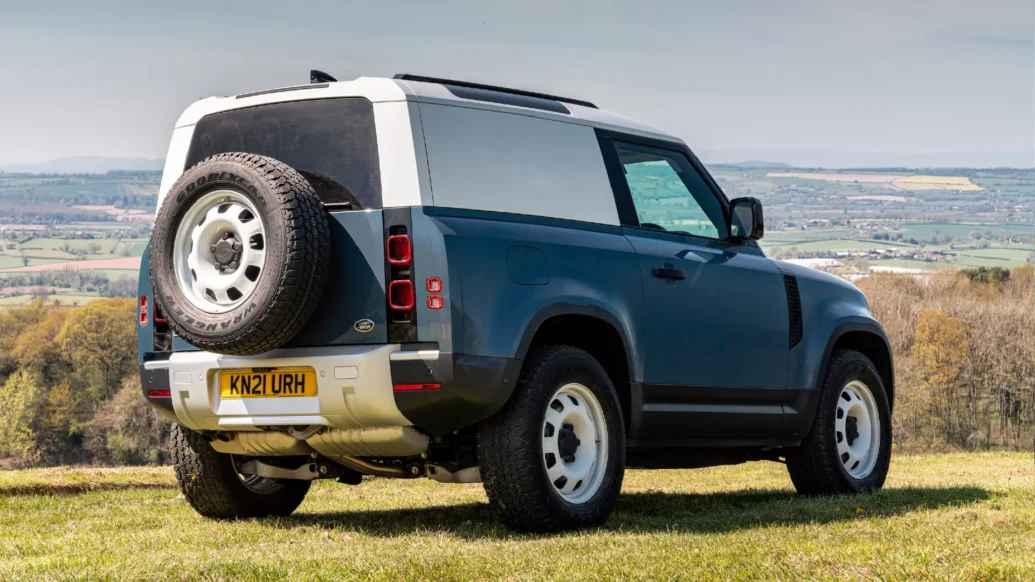
The Land Rover Defender Hard Top has overtaken the Ford Ranger in registrations as punitive tax changes drive businesses away from double-cab pickups and towards commercial 4x4s.
September saw 1,453 Defender Hard Tops registered, compared with 1,421 Ford Rangers. The margin is even tighter across 2026 as a whole, with the Defender recording 6,958 registrations against 6,953 for the Ranger.
A five-vehicle lead may be narrow, but the wider market direction is hard to ignore.
Land Rover commercial 4×4 registrations rose by around 256% in September, while total demand for commercially registered 4x4s more than tripled, rising 221.3% to 2,079 vehicles.
Pickup registrations fell sharply in the opposite direction, down 53.8% to 2,658.
Commercial 4x4s absorb former pickup demand
The pattern is also visible across the first nine months of 2026.
Commercial 4×4 registrations have risen by 67.7% to 9,222, while the pickup market has fallen by 55.5% to 13,172 vehicles.
It’s increasingly clear that some buyers who might previously have chosen a double-cab pickup are moving into vehicles such as the Defender Hard Top.
Not all the missing pickup demand has transferred, though. Combined registrations across the pickup and commercial 4×4 categories still fell by around 26% during September. Commercial 4×4 growth is cushioning the pickup decline rather than entirely replacing the lost volume.
Why is the Defender Hard Top benefiting?
The shift follows changes introduced in April 2025, when most double-cab pickups began to be treated as passenger cars for benefit-in-kind and capital allowance purposes.
Company drivers choosing a diesel double cab now face tax based on the vehicle’s list price and CO2 emissions, generally placing it in the highest company-car tax band and leaving some drivers with tax bills beyond £8,000 a year.
The Defender Hard Top avoids that problem. It’s homologated as an N1 commercial vehicle and retains flat-rate van benefit-in-kind treatment. It also qualifies for the £360 commercial vehicle rate of road tax.
That makes it an increasingly logical alternative for users who require towing ability and serious off-road performance but don’t need rear seats or an open cargo bed.
The Defender Hard Top is available with two or three front seats, while the longer 110 version provides up to 2,059 litres of secure load space. It can tow up to 3,500kg and offers a maximum payload of up to 770kg, depending on specification.

It won’t replace a pickup for every operator. Its payload falls short of the one-tonne capability traditionally offered by pickups, and an enclosed cargo area won’t suit users carrying oversized, dirty or loose materials.
But for businesses transporting tools or equipment, the Defender — and rivals like the KGM Rexton Commercial — combines secure storage and genuine off-road ability with far more favourable company-vehicle taxation.
Ford Ranger still dominates shrinking pickup sector
The Ford Ranger remains the UK’s most popular pickup, accounting for more than 53% of all pickup registrations in September and year to date.
Its loss of the broader commercial 4×4 crown therefore says more about the segment’s collapse than the Ranger’s position within it.
New models, including the Mitsubishi L200 and forthcoming BYD Shark, will add more choice, while plug-in hybrid and electric pickups could reduce company-car tax costs for some drivers.
Nevertheless, September’s figures show how quickly the market is changing. Businesses still need vehicles with towing capacity and off-road ability, but many no longer need those vehicles to be pickups.
