
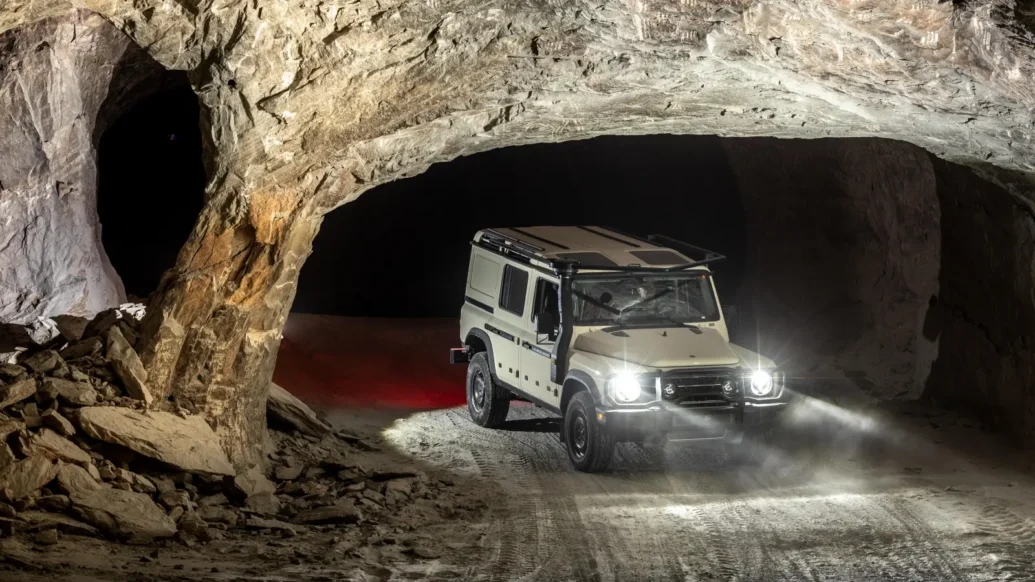
An Ineos Grenadier is undergoing a demanding trial 1,300 metres underground at the K+S potash plant in Zielitz, Germany. The mine’s salt-rich environment places significant demands on any vehicle operating within it, making it perfect for testing the Grenadier’s durability and capabilities.
The K+S plant spans over 23 square miles and extracts around 45,000 tons of raw salt each day. Despite needing to withstand these conditions, the Grenadier has been left with its standard corrosion protection, with the chassis receiving complete electrocoating, wax sealing in the cavities, and powder coating on the outside. The vehicle is also protected with tough underbody protection, front and rear guards, and a fuel tank guard.
“Extreme testing conditions are not new to the Grenadier as we really put it through its paces during development,” explains Lynn Calder, CEO at Ineos Automotive, “but it’s great to work with partners around the world to showcase just how capable this 4×4 is on-road, off-road and now underground.”

During the development of the Grenadier, Ineos put the vehicle through more than a million miles of testing in extreme conditions, from temperatures as low as -35°C to heights of more than 2,500m, and including tackling Austria’s notorious Schöckl mountain.
The Grenadier’s backbone is a full box-section ladder frame chassis with heavy-duty solid beam axles, a two-speed transfer case, and up to three locking differentials. It’s powered by a BMW 3.0-litre turbo-charged inline six-cylinder petrol or diesel engine, which has been specifically calibrated for the Ineos vehicle.
The Grenadier Utility Wagon in use in Zielitz is joined in the range by the Station Wagon, as well as the newly introduced Commercial van and Quartermaster pickup and chassis cab models.

- BYD Shark earns five-star Euro NCAP safety rating - 19 October 2026
- Land Rover Defender Hard Top overtakes Ford Ranger as pickup demand collapses - 5 October 2026
- Chery Stockman diesel hybrid pickup packs 476hp and 60-mile electric range - 2 October 2026