
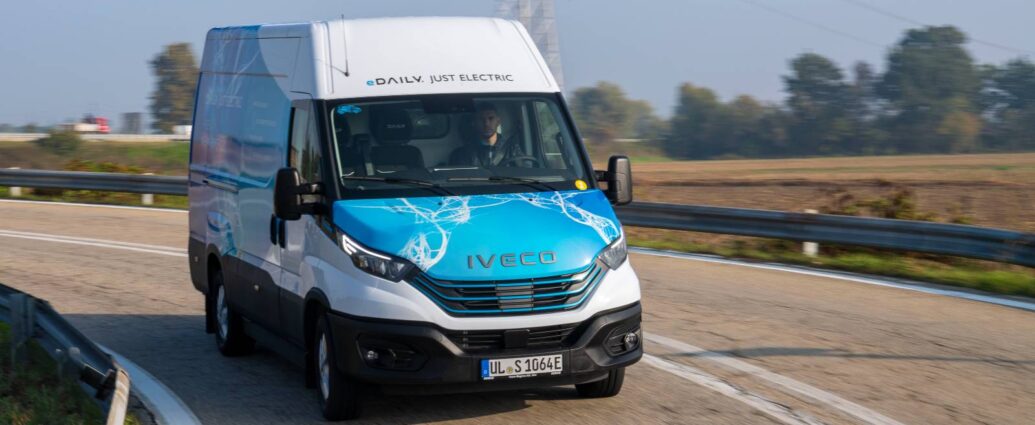
If you’re thinking that the Iveco eDaily isn’t new, then you’re right. But you’re also wrong. The Daily Electric did exist, but with peak power of less than 110hp, it was pitifully underpowered as well as frighteningly expensive.
Happily, this latest version — rebadged from Daily Electric to eDaily — has improved in every area. It’s still built around a heavy truck-inspired chassis, which offers a swathe of benefits and a handful of downsides, but now there’s a modern electric drivetrain, impressive backup from Iveco, and more flexibility than you’ll find in most rivals.
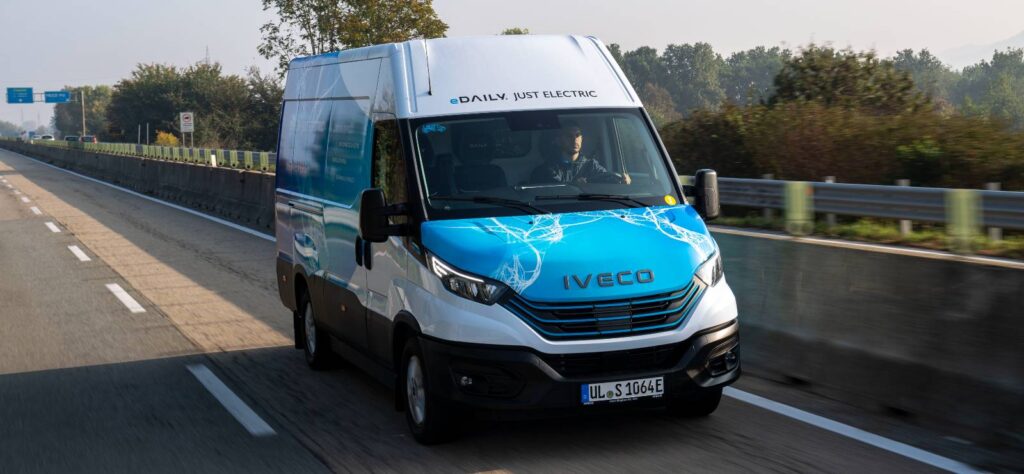
Externally, there’s little to differentiate the regular diesel-powered model from the eDaily, but look carefully, and you’ll spot new ‘IVECO’ text across the bonnet and some blue detailing dotted around the van.
Under the skin, there are more significant changes. The electric motor now produces 190hp, powered by battery packs slotted between the chassis rails. These are assembled in a factory adjacent to Iveco’s plant, with each pack providing 37kWh of power. It drives the rear wheels via a traditional but short prop shaft, eschewing the trend for an e-axle with the motor built in.

We’re in the 3.5-tonne model, but Iveco will sell you an eDaily, which can take one or two battery packs. With two in place — depending on spec, you can choose between one, two or three packs — it’ll run for up to 146 miles, according to official WLTP testing. A 4.25-tonne variant will be available too, enabling those that have completed a short training course to drive with just a category B driving licence (the normal car licence), with the range growing to 7.2 tonnes GVW.
The new eDaily still has the tough truck-based build of the Daily, and now it’s got the performance, range and flexibility to keep up with the best on the market. But is that enough? We drive an early model ahead of its arrival in the UK and find out…
Iveco eDaily: Cabin
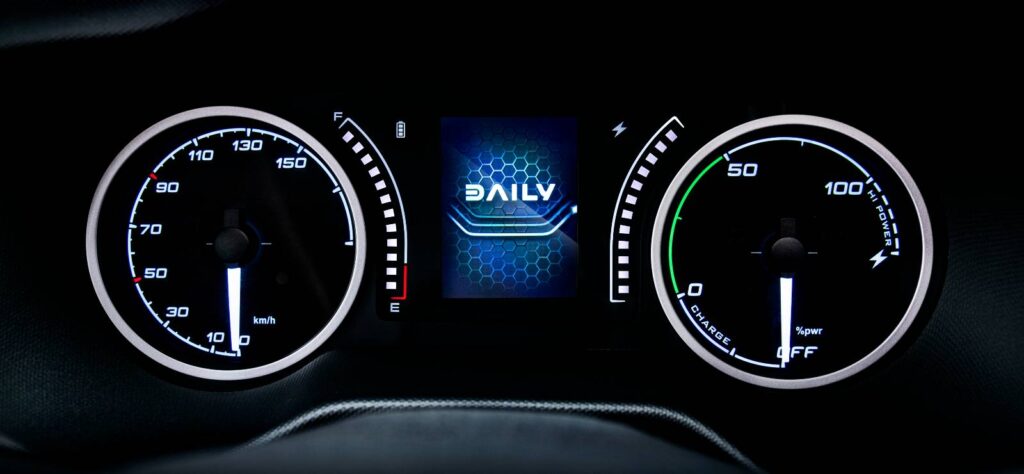
The Daily received a facelift in 2019, where the cabin got a refresh, but it’s not the last word in modern design. The thick-rimmed, slightly squared-off wheel sits in front of an instrument panel that’s half analogue, half digital. Buttons on the wheel control most functions on the small screen ahead of you, which is easy enough to operate and shares some helpful info — including how much load you’ve got in the back of the van, which could come in very useful if you’re getting close to your payload limits.

Other functions are dealt with via the infotainment screen in the dashboard’s centre. This 7.0-inch unit looks and feels small in such a large vehicle, but it works well enough. Depending on spec — and we don’t know what that will look like in the UK just yet — you’ll find smartphone mirroring with Android Auto and Apple CarPlay, a DAB radio and a navigation system. The latter uses TomTom’s system that can navigate around width and height restrictions.
It’s all wrapped up in a cabin that’s fine, if unexceptional, to live with. There’s storage for your bits and pieces all over the cabin, including twin boxes on top of the dashboard, a glovebox, a grippy shelf, under-seat storage, and multiple options in the doors. In the centre of the dashboard, there’s a section that can be specified in different ways, with the A4 paper-sized slot and USB port in our van being a thoroughly sensible use of the space.
One frustration has gone; the awkwardly positioned cup holder has been replaced with controls for the suspension, at least on our pneumatically suspended test model. A new frustration has arisen, though; there’s no replacement cup holder.
Other changes between the Daily and eDaily are few and far between, so it’s the same cabin you’ll already be familiar with.

Iveco eDaily: On the Road
There’s something inherently relaxing about driving an electric vehicle, which holds true for a van as much as it does for a car. It’s only when you spend a lot of time in one that you realise the things you’re missing; a noisy engine, vibrations and rattles throughout the cabin, and the shudder as the stop/start system kicks in. By switching to electric, you lose all that and find yourself in a quiet, harmonious environment.
Of course, that’s no use if the underlying qualities of your van aren’t up to scratch. Iveco hasn’t strayed too far from its lane with the eDaily, taking the best bits of the well-respected Daily van and simply replacing the engine with an electric motor and some batteries.
The electric motor provides peak power of 190hp, with a torque figure of 400Nm. That’s enough to shift the 3.5-tonne eDaily we’re testing with sufficient pace to hold your own on the city streets and the motorway. However, it only tells half the story; those peak figures aren’t always available, limited to bursts of two minutes, with the eDaily using just 120hp and 220Nm of torque under everyday driving. Fortunately, even with half a tonne of cargo in the back, that didn’t hold it back at all — it was as home in the congested city as it was out on the motorway, where it was more than happy to cruise along at 70mph.
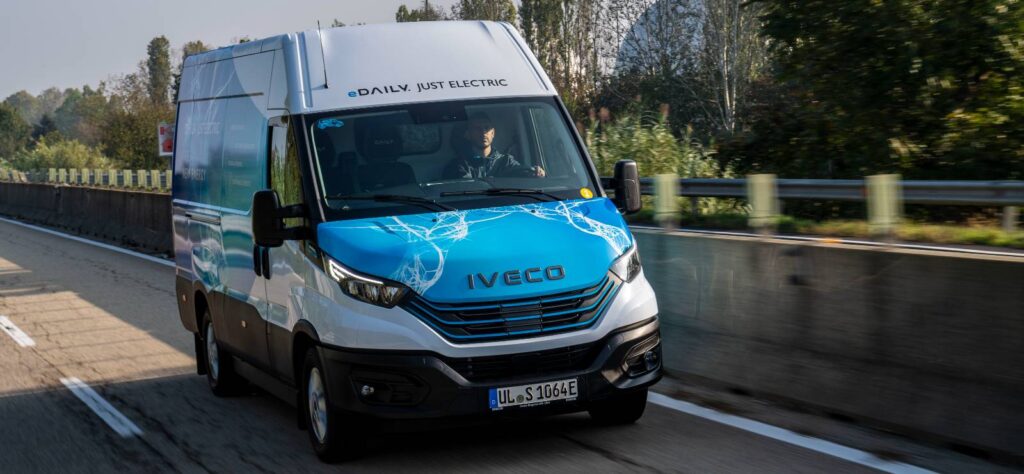
Once on the move, throttle responses were near-instant, allowing us to easily keep up with the traffic flow. However, it’s less convincing from a standstill, where there’s a significant pause before power is fed through to the wheels, which can cause a few anxious moments when pulling onto a busy road.
Handling, while not quite as sharp as the likes of the Mercedes-Benz Sprinter or Volkswagen Crafter, is fine and predictable, with the eDaily holding a pleasingly stable line at speed. The steering is a bit lifeless, with an odd dead area in the centre with resistance increasing rapidly as you rotate the wheel beyond 30 degrees or so. For city work, a button helpfully marked ‘City’ helpfully increases assistance, making the Daily as light and easy to manoeuvre as a Ford Fiesta .
.
With independent front suspension and optional ‘Air-Pro’ pneumatic suspension at the rear of our van, the ride quality was impressive — although it’s likely to be as bouncy as any other Daily when running empty — and that was boosted further by the suspended driver’s ‘Hi-Adaptive’ seat.
Iveco eDaily: Economy and Running Costs
There’s no pricing available for the eDaily yet, as there are still some months before it makes it to the UK. However, we can look at other costs associated with the eDaily, which mostly come down to energy.
Electricity prices are in flux, which will cause concern for many, but diesel prices aren’t demonstrably stable, either. Unlike diesel, what you pay for electricity can vary wildly, from as little as 5p per kWh right up to £1 per kWh — that’s a 20-fold difference.
Iveco has been clever in striking a balance between battery capacity and cost. At its simplest, more battery power gets you further down the road but adds weight and cost. Iveco has got around that by letting you choose how much battery you need. It’s not quite as granular as you might hope for, with the 3.5-tonne van limited to a choice of one battery (37kWh) or two (74kWh).
Ours has the twin set, which is good for a range of 146 miles. The 4.25t model with a trio of batteries is good for 186 miles, at least according to WLTP testing. Anecdotally, with half a tonne on board and some enthusiastic driving, we were looking at a range of 118 miles. A light right foot will improve on that.
Three driving modes aim to help, with Natural being an everyday programme, and Power and Eco doing what they say — the former unleashing all 190hp, while the latter limits power and cuts down energy use by ancillaries such as the air conditioning.
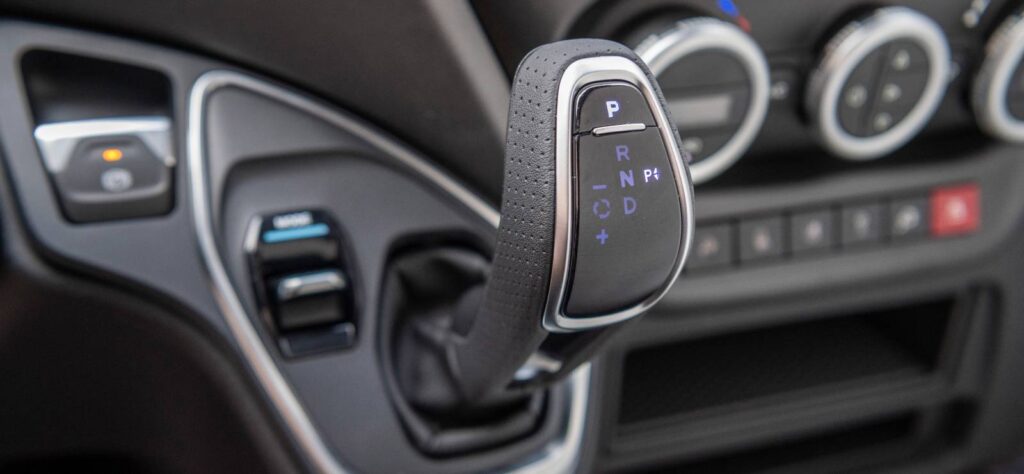
Three energy recuperation options join the driving modes: Standard, One Pedal and Sailing. Standard replicates engine braking from a regular diesel model, slowing the van and recovering energy that would typically be lost. Sailing mode cuts the braking and lets the van coast along, which is handy on a motorway. One Pedal mode increases the strength of the ‘engine’ braking and allows you to control acceleration and braking using the throttle pedal alone. It’s a similar system as found on most electric cars and, once you get used to it, is a cinch to use. It’s not flawless in the eDaily, though, where there are too many times you’ll need to break into two-pedal driving and hit the brake pedal.
Recharging is easy enough, although the maximum rate is limited to 80kW. That means a charge from around 15% battery charge to 80% will take around half an hour on a suitable rapid charger. Overnight charging on a dedicated home or workplace charger will take a little over 10 hours from empty to full, although bear in mind that you’ll rarely run the battery to empty.
Iveco’s impressive active monitoring and support service will be available, with a ‘Customer UIptime’ centre able to provide real-time data monitoring with proactive and predictive diagnosis to prevent downtime. Owners can access this information through a digital dashboard, even at the owner-operator level — there’s no need for a fleet manager or overwhelming maintenance contract.
Iveco also warrants the battery for eight years or 150,000 miles, although that’s cut to 100,000 miles on variants with just the one battery pack. Assuming all the conditions are met, it’ll be replaced if your battery pack drops below 80% capacity in that time.
Interestingly, if your business needs change in that time, it’s possible to change the battery pack to meet your demands better. If driving distances extend — perhaps you have a new client who’s further away — then an Iveco dealer can add another battery pack or two to the van, potentially tripling its capacity and range. There’s no pricing for that just yet, but it’s likely to be significantly cheaper than replacing the vehicle.
| GVW | 1 Battery (37kWh) | 2 Batteries (74kWh) | 3 Batteries (111kWh) |
|---|---|---|---|
| 3.5t | 75 miles | 146 miles | – |
| 4.25t | 68 miles | 124 miles | 186 miles |
| 5.2t | – | 115 miles | 162 miles |
| 7.2t | – | 75 miles | 112 miles |
Iveco eDaily: Payload and Towing
Look underneath the eDaily, and you’ll see that it’s closely related to a truck. There’s a rugged ladder chassis in place, and it’s engineered to reach a GVW of 7.2 tonnes while still towing up to 3.5 tonnes. For moving heavy but relatively compact loads in the city, it’s unbeatable.
However, that engineering comes at a price, and that’s payload limits on the entry-level 3.5t models. For our test van, a 3.5-tonne panel van with two battery packs, there’s a 920kg payload limit for the 12m3 cargo box.
Still, with more than 200 variants to choose from — including five body lengths and three roof heights — there’s a good chance you’ll be able to find a variant suitable for your business. At the extreme, extending the payload capacity to 4.6 tonnes is possible, and load volumes can reach as much as 20m3. To put that into context, the Ford E-Transit maxes out at just under 1.8 tonnes and 15.1m3.
Of course, move beyond the 3.5t GVW model to access all of that extra capacity, and you’ll lose the ability to drive the van on a standard car licence.
The truck-based engineering holds extra benefits outside of carrying heavy payloads and huge volumes. Bodybuilders will find it easy to convert the eDaily to almost anything, with three types of electric power take-off available, offering outputs of up to 15kw. Operating tail lifts, refrigeration units, or pumps becomes a cinch, with clever electronics allowing you to continue working without affecting the main drive battery. To prove the point, Iveco demonstrated a couple of conversions, including a compact refuse truck and a supermarket-ready refrigerated box van.
Unique amongst electric vans, the eDaily can tow loads up to 3,500kg. Yes, this will make a significant dent in the driving range available, but if needs must, then the ability is there.
| Kerb weight | 2,580kg | Load bay length | 3,540mm |
| Gross vehicle weight (MAM) | TBC | Load bay width | 1,800mm |
| Payload | 920kg | Load bay height | 1,900mm |
| Gross vehicle mass | 3,500kg | Load bay capacity | 12.0m3 |
| Towing capacity (unbraked) | 750kg | Towing capacity (braked) | 3,500kg |
Iveco eDaily: Verdict
It’s a little tricky to come to a definitive conclusion as, being so far ahead of the UK launch of the Iveco eDaily, we don’t know details on pricing and specifications. However, there are some elements we can be sure of that work for and against the van.
There’s no doubt that the electric drivetrain is impressive and offers a level of flexibility that the likes of the Ford E-Transit just can’t match, especially when you consider the ability to chop and change battery packs throughout the van’s life.
Truck-based engineering also offers significant advantages, especially when moving up the range. The ability to carry up to 4.6 tonnes of payload or squeeze in 20m3 of cargo is compelling, especially when the eDaily still feels like a large van rather than a small truck.
However, that strength is also its greatest weakness. For owner-operators or small businesses, the licensing restrictions on drivers mean operating anything over 3.5 tonnes becomes fraught with difficulties. It’s at that point that the payload options become rather more limiting.
These limits also mean it’s up against the Ford E-Transit, which, frankly, is a better-resolved package with a more pleasant and refined cabin. The Ford edges it if this is your van rather than just a works van.
However, if you’ve got your licence sorted, want to shift huge amounts of cargo, or need a heavy-duty conversion, there’s nothing to rival the eDaily. If it’s right for you, it’s an impressive package, but we’ll know for sure in the spring, when the UK models arrive.
Model tested: Iveco eDaily 35S14E V/P
| Basic price | TBA | On the road inc VAT | TBA |
| VAT | TBA | Model range exc VAT | TBA |
- BYD Shark first drive review: A different kind of working pickup
 Is your electric pickup ready for remote work? A guide to mobile charging
- BYD Shark earns five-star Euro NCAP safety rating
 Where the highway meets the wild – life on the road behind the wheel of a truck
- Land Rover Defender Hard Top overtakes Ford Ranger as pickup demand collapses

- BYD Shark first drive review: A different kind of working pickup - 22 October 2026
- Is your electric pickup ready for remote work? A guide to mobile charging - 21 October 2026
- BYD Shark earns five-star Euro NCAP safety rating - 19 October 2026