
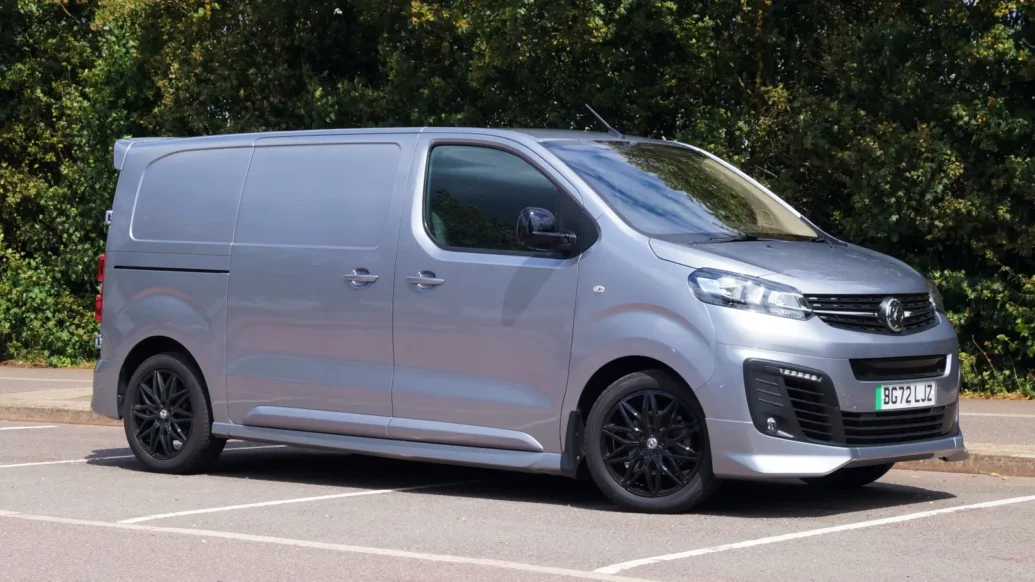
When your parent company makes the same product wearing five different badges, how do you make your version stand out? Vauxhall thinks it has the solution, creating the GS, a sporting version of the Vivaro Electric panel van that we review for you.
Underneath the spoilers and side skirts, it’s the same van as you can buy from Citroen, Fiat, Peugeot and Toyota, but despite the skin-deep changes, Vauxhall has successfully come up with a van that looks and feels different to its siblings.
Spotting the GS isn’t difficult, thanks to GS-specific 18-inch alloy wheels, a lip spoiler at the front, side skirts and a roof-mounted spoiler at the back that apparently improves stability when running empty. There have been changes inside, although they’re less noticeable, with GS-branded leather seats, a smart steering wheel and some GS logos dotted around.

It’s all a cosmetic exercise, though, as there’s no more power. Underneath the bonnet is a 136hp electric motor powered by a 75kWh battery pack, which is identical to the drivetrains in its Stellantis-built rivals.
Vauxhall Vivaro Electric GS: Cabin
The electric version of the Vivaro differs from the regular van, and it’s better for it. Gone is the gearstick, replaced by a small rocker switch to select forward or reverse gears — there’s no need to do more than that with an electric motor — although it still sits on a protruding lump of dashboard that reduces knee room for any passenger in the centre seat.

There’s also a digital instrument cluster, showing everything you’d normally expect to see, with the addition of a handy meter showing how much power you’re using and an extra guide on how much energy the climate control system is draining from the battery. That’s handy to know when you’re running a little low.
Other than that, it’s the same as every other Vivaro, bar some leather seats and a few GS logos placed around the cabin. It’s usable enough, but it needs a refresh — the small, matt 7.0-inch infotainment screen feels seriously outdated compared to the glossy 13.0-inch unit you’ll find in the new Ford Transit Custom. Still, it’s got Android Auto and Apple CarPlay so that you can avoid the built-in software.
You’d be tempted to put your smartphone in a handy tray that’s next to the USB socket, but you’ll soon find that it’s not large enough for any modern phone, so it’ll shoot out and land under the seats or pedals at the first corner.

The rest of the cabin is fine, if unremarkable. There’s enough room for the driver and two mates, although the centre passenger won’t be particularly happy with their lot thanks to the gear selector housing that encroaches on knee room. The driver will also note the offset driving position, with arms going left and legs going right, which can get tiring on a longer journey.
Vauxhall Vivaro Electric GS: On the Road
With the same chassis, suspension and electric motor as the Vivaro Electric has always had (from when it was known as the e-Vivaro), there are no surprises in how the van performs, but that’s no bad thing — the 136hp motor gives enough power to be almost entertaining to drive, especially when empty.
Three driving modes help you extract the most, with the default mode limiting power to 80% or about 110hp. Eco mode cuts that further, by 40%, reduces throttle response and minimises the climate control system’s energy use. It’s a miserable experience, but it will help you eke out a few more miles from the battery.

Sport mode unleashes all 136hp, and there’s enough to light up the front wheels on the exit of a junction. That’s not particularly useful, of course, but the 260Nm of torque shows there’s enough oomph to get the van moving with surprisingly alacrity. It’ll keep accelerating up to motorway speeds (and beyond) without leaving you feeling like you’re straining the van, although that seriously eats into the available range. As will carrying a heavy load, although the 300kg or so we were carrying barely made a dent.
Officially, it’ll manage 197 miles on a full charge, and during its time with us, we were getting only a little less than that on average, at 180 miles to a full battery, although that was under relatively light use.

Around town, where the strain on the van is at its lowest, it’s a lovely thing. The steering is light as a feather, and the van has good visibility, making urban manoeuvring a piece of cake. The ride is good, too, with suspension soft enough to absorb most of the cracks and potholes on the roads without upsetting the passengers.
The ride remains fine right up to motorway speeds, and, of course, there’s never any of the noise and vibration you’ll get from its diesel-powered twins.
Vauxhall Vivaro Electric GS: Economy & Running Costs
The elephant in the room is the £57,800 asking price for the Vivaro Electric GS, and that’s before VAT. That’s £14,800 more than the diesel-powered Vivaro GS, although the van is eligible for the plug-in van grant , which will reduce the price by £5,000 — the scheme changes frequently, though, so check the latest rates. Still, that’s around £10,000 that you’ll need to recover in lower running costs.

Happily, there are some significant savings to be made by switching to electricity, though, which means it may well work in your favour. Get your spreadsheet out and start adding up the savings from avoiding ULEZ and congestion charges, reduced maintenance costs, and (usually) lower fuel costs.
The 197 miles range from the 75kWh battery (the GS doesn’t get the option of the cheaper but less useful 50kWh battery) even when running fully loaded in the middle of winter. Granted, if your role involves long motorway drives each day, it’s probably not right, but the average van covers just 50 miles a day, leaving you plenty of spare capacity.
When you need to recharge, you’ll likely be able to do that at home or a depot, where it could cost as little as £8 for a full charge, assuming you can get onto a suitable tariff. If you need to use expensive rapid chargers, you can squeeze in energy at a rate of 100kW, meaning a 20-80% charge should only take about half an hour.

After the first service, you’ll only need to see your dealer every two years or 25,000 miles. A three-year or 100,000-mile warranty backs the van, with cover on the battery pack extended to eight years.
Safety technology has been loaded onto the Vivaro, which gets a Silver award from the Euro NCAP safety experts — with the extra kit fitted that’s usually an option on lesser models, we feel the GS might have even scored a Gold. You’ll find automatic emergency braking, lane departure warning, automatic lights and wipers, blind spot detection, parking sensors, a 360-degree camera system, and other safety technology onboard, which should help avoid accidents, lower insurance premiums, and reduce repair costs.
Vauxhall Vivaro Electric GS: Payload and Towing
To keep things simple and no doubt emphasise the sporty nature of the van, Vauxhall offers the Vivaro Electric GS in just one body size — the short wheelbase version with a low roof.
Even with that limitation, it’s a spacious van. Loads up to 2,512mm long and 1,636mm wide can fit in the back. With a roof height of 1,397mm, the maximum cargo volume is 5.3m3, which is on par with its rivals. A clever load-through option extends the cargo box through the bulkhead under the passenger seat, allowing you to slot long, thin objects up to 3,674mm long in the van. It makes the seat unusable but adds some helpful flexibility to the van.
The low roof height ultimately limits the volume available but does have the advantage of making it easy to take the van into multi-storey car parks or other low-roof locations.

There’s a sliding door on either side of the Vivaro, while barn-style doors at the back swing open to 180 degrees. The result is a load area accessible easily, including with forklifts, where you’ll be able to slide two Euro pallets into the van.
Payload limits are fine if unremarkable. The GS will take a 1,000kg load and tow another 1,000kg.
| Kerb weight | 2,025 kg | Load bay length | 2,512 mm |
| Gross vehicle weight (MAM) | 4,100 kg | Load bay width | 1,636 mm |
| Payload | 1,000 kg | Load bay height | 1,397 mm |
| Gross vehicle mass | 3,025 kg | Load bay capacity | 5.3 m3 |
| Towing capacity (braked) | 1,000 kg | Towing capacity (unbraked) | 750 kg |
Vauxhall Vivaro Electric GS: Verdict
I was initially sceptical about the Vivaro Electric GS. The van is instantly familiar, with little to differentiate it from its Stellantis-made siblings beyond some cosmetic add-ons and a few GS badges, but it somehow comes together and just works. Owner-operators will like the extra dash of style and the slightly more premium cabin, while the safety kit is a strong plus point. If you want a bit of sporting style along with class-leading cargo volume and competitive payload limits, then the GS is the only option, but the rest of the Vauxhall Vivaro Electric range (and the same vans from Citroen, Fiat and Peugeot) all offer the same abilities.
Ultimately, there’s no logical reason to pick the GS over a Vivaro Electric Pro van, especially when there’s more than £10,000 between them. No matter how much we like them, that’s an expensive set of spoilers.
Model tested: Vauxhall Vivaro Electric GS L1 Panel Van
Professional Van Rating: ★★★☆☆
| Basic price | £57,050 | On the road inc VAT | £69,350 |
| VAT | £11,410 | Model range exc VAT | £40,355–57,050 |

- BYD Shark first drive review: A different kind of working pickup - 22 October 2026
-
 Is your electric pickup ready for remote work? A guide to mobile charging - 21 October 2026
 - BYD Shark earns five-star Euro NCAP safety rating - 19 October 2026