
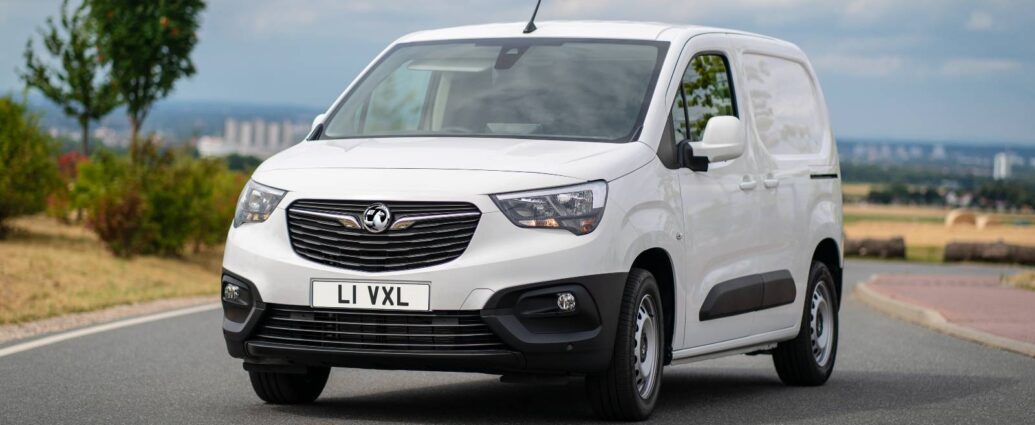
It’s easy to be swayed by the endless equipment list on modern vans that edge ever closer to lifestyle or family vehicles, but the Vauxhall Combo Cargo Edition van we’ve got here is about as far removed from that level of luxury as you can get.
The Combo is one of a quadruple of near identical vans — squint, and you’ll never tell the difference between this and the Citroen Berlingo and Peugeot Partner. The Vauxhall badge isn’t working for the Combo in the same way it does for its big brother, the Vivaro, which is the second-best seller in its segment, and the third-best seller overall. For the year to date, the Combo hasn’t even made it into the top ten, comprehensively outsold by its French-badged siblings.
That’s not for the lack of flexibility. There are two body lengths, four engines, one 4×4 model, and four trim levels (although Vauxhall has since rationalised the range.) You’ll also be able to order a Combo Electric, which, as the name suggests, is powered by an electric motor.
The regular panel van range starts with this, the sparsely equipped Edition specification. Dynamic adds valuable equipment, including air conditioning, steering wheel-mounted audio controls, cruise control and parking sensors. The Sportive level adds an 8.0-inch touchscreen infotainment system and some styling updates such as metallic paint, body-coloured bumpers, and 16-inch wheels with full trims. At the top of the range, Elite adds satellite navigation, reversing camera, automatic lights and wipers, and 16-inch alloy wheels.
The lengthy equipment list is appealing, but we’re testing the entry point to the range, the Combo Cargo Edition. It’s cheap, but is it cheerful?
Vauxhall Combo: Cabin
Despite its bargain basement specification, the cabin of the Cargo Edition is quite pleasant. The dashboard is angled towards the driver, with a pair of vents sitting below the radio. There’s no swish infotainment system with a large touchscreen on the Edition trim level. Instead, you’ll find some touch-sensitive buttons around the kind of tiny LCD screen you’d expect to find in a 1990s Toyota.

There is a USB socket, so you can plug in your phone and play music from there (with a tray underneath that will hold most phones), and you’ll find a DAB radio and Bluetooth connectivity, but that’s about it.
Oddly, it’s quite refreshing to go back to relative basics. It’s not immediately intuitive, but once you’ve figured out the controls, it’s a no-nonsense system that keeps distractions to a minimum. Yes, the likes of Android Auto and Apple CarPlay would be nice, but you’re as likely to stick a phone to the windscreen as you are to plug in and set up those systems, especially on a pool vehicle.
There are physical buttons for the heating and ventilation, which would typically be a point to celebrate. However, while they’re still better than a touchscreen system, the controls are small, difficult to reach and poorly illuminated at night.

They sit behind a large protrusion that hosts the manual gearbox — five gears only on this model — which eats into knee room, including for the driver’s left knee.
The instrument binnacle is typically straightforward and unexciting. Vauxhall does this well, displaying all the information you need without superfluous additions. What is missing are steering-wheel-mounted controls; the three-spoke wheel with plastic blanking plates looks oddly old-fashioned, but with no infotainment system to operate, there’s little need for the buttons to exist.
Cabin space is plentiful, helped by the van being a two-seater. That makes it feels roomier than the usual models fitted with a two-person bench on the passenger side. You can add that as an option, and higher specifications models include it, but many won’t miss its absence.

Vauxhall Combo: On the Road
While an electric version of the Combo is available, most are still powered by a diesel engine. For those with very specific needs, there’s even a 110hp petrol model, although sales of this are few and far between.
The diesel range starts with the 75hp engine and runs through 100hp before topping out with the 130hp option. All are based on the same 1.5-litre engine, with different states of tune.
We’re in the mid-range model that provides 100hp and 250Nm of torque. It’s a relatively modern engine and quite refined too, so long-distance cruising is a reasonably pleasurable experience.

That’s helped by suspension that’s been tuned for comfort rather than handling. Despite being able to carry a payload of 998kg, it’s soft enough to cope with most imperfections in the road, with long-frequency bumps on the motorway disappearing beneath the van.
The soft suspension helps around town, too, where it copes with cracks and potholes quite nicely. A reasonably tight turning circle also makes it easy to manoeuvre, although you sit a long way back from the windscreen, which makes judging where the corners of the van are quite tricky.
The compact dimensions and car-like suspension make it a little too soft when tackling country roads. It remains comfortable, but the body starts to roll in corners, even when driving without a load, which makes it feel rather vague.
Vauxhall Combo: Economy and Running Costs
The list price of the Combo Cargo is competitive, with the range starting at £17,580. The best value model is the Dynamic model with the same 100hp engine, which gains a significant amount of equipment for little extra outlay, and you’re likely to get most of that back come resale.
The 100hp model promises fuel economy of 51.4mpg, which is optimistic. Our testing, which included some long motorway runs and some city driving, saw the van return 42.8.mpg. In fairness, that’s a good result and competitive with its rivals. It’s exactly what we’d expect from its sibling at Citroen, Peugeot and Toyota.

A 50-litre diesel tank means you’ll be able to run for 565 miles between fuel station visits, theoretically. There’s also a 17-litre AdBlue tank that will need topping up occasionally.
Service intervals are long, with the Combo requiring a dealer visit once every 25,000 miles or every two years. That said, the van will monitor itself and tell you if it needs to see a dealer ahead of schedule.
If things go awry, a three-year warranty will cover most issues, valid for up to 60,000 miles. That compares poorly to the identical Toyota Proace City’s warranty cover, which can extend for as long as 10 years with the Toyota Relax offering. Likewise, the same van from Citroen or Peugeot will be covered for up to 100,000 miles.
Vauxhall Combo: Payload and Towing
Open the doors of the Combo — there are twin rear doors and a single sliding side door — and you’ll find a surprisingly spacious cargo area. Our test van is the L2 model, so the longer of the two variants available, which means you can slide a load up to 2,167mm long in the back.
There’s just one roof height, giving an internal height limit of 1,243mm. At the broadest point, the cargo area is 1,527mm from edge to edge, which drops to 1,229mm between the wheel arches. There’s enough space to squeeze a couple of euro pallets in the back.

As you might expect, the rear doors fold out by 180 degrees, so you’ll be able to forklift a pallet into the back without issue. The side door leaves a gap that’s 675mm wide.
The dimensions are close to those of the Ford Transit Connect, which is marginally shorter (-15mm), slightly taller (+26mm) and a little narrower (-21mm). The Ford is a centimetre or two wider between the wheel arches, and the side door is a couple of centimetres smaller. Fundamentally, there’s next to no difference between the two in terms of space in the cargo area.
While not fitted to this Edition specification, some trim levels get Vauxhall’s FlexCargo system included, which provides a load-through bulkhead underneath the passenger seat. This allows longer items — up to 3,440mm — to be loaded through, with a protective bag offering protection to the driver from any loose cargo. It will only be suitable for very small but long loads, and means there’s no way of using the passenger seats, but it does extend the practicality of the van.

Payload limits are high for the sector, ranging from 650kg to 1,025kg. This specific model can take 998kg, which is considerably more than the Ford Transit Connect’s 865kg for a similarly specified model.
Vauxhall once offered an overload sensor in the Combo that monitored the load in the cargo area, providing a warning when getting close to payload limits and a further notice when exceeding them. Sadly, it’s been deleted from the equipment lists and isn’t even available as an option.
| Kerb weight | 1,347 kg | Load bay length | 2,167 mm |
| Gross vehicle weight (MAM) | 3,345 kg | Load bay width | 1,527 mm |
| Payload | 998 kg | Load bay height | 1,243 mm |
| Gross vehicle mass | 2,345 kg | Load bay capacity | 3.9 m3 |
| Towing capacity (braked) | 1,000 kg | Towing capacity (unbraked) | 750 kg |
Vauxhall Combo: Verdict
Going back to basics isn’t as painful as it could be. Truth be told, it’s quite nice not to have a large infotainment screen shining at you all day, demanding attention when you really should have your eyes on the road.
However, having a phone stuck to the windscreen for navigation and entertainment, with a cable flopping down to the USB port on the dashboard, isn’t an entirely safe option, either.
This means, for all of the appeal, a higher specification Combo makes more sense than this Edition specification, especially as you benefit from some near-essential niceties like air conditioning and a cabin and cargo area alarm system.

Beyond the cabin, the Cargo is a pleasing van to drive and has a cargo area that’s competitive with its rivals.
The problem is that its rivals are rather talented. The Ford Transit Connect is better to drive and just as spacious in the back, although the maximum payload is quite a bit lower, and the new Renault Kangoo is bang up to date, offering a more car-like experience than ever before.
And then there are the other models from Stellantis, owners of Vauxhall. The Citroen Berlingo, Fiat Doblo and Peugeot Partner are all mechanically identical, with little more than equipment lists differing between them. List prices and finance rates will vary, so choose the best deal.
There’s a fifth version of the van that carries a Toyota badge. The Proace City is, again, mechanically identical but is backed up by the well-respected Toyota Professional network. More important;y, at least for the owner-operators and small businesses that tend to keep their vans for longer than a three-year lease cycle, there’s warranty cover than can last for as long as 10 years. That should see most owners through for the life of their van, allowing them to predict future costs and ensure that their investment won’t become a liability.
We’d visit the Toyota dealer ahead of the Vauxhall showroom.
Model tested: Vauxhall Combo Cargo Edition 2300 1.5 (100PS) Turbo D
| Basic price | £18,455 | On the road inc VAT | £23047 |
| VAT | £3,689 | Model range exc VAT | £17,580-£23,380 |
- Renault Niagara pickup revealed, but it’s only for Latin America

- Mitsubishi L200 Commercial swaps rear seats for van tax treatment
- Volkswagen launches blacked-out Amarok Dark Label pickup
- Pickup market plunges to lowest level since Covid lockdown
- KGM appoints Mertrux as new Derby dealer


- Renault Niagara pickup revealed, but it’s only for Latin America - 10 September 2026
- Mitsubishi L200 Commercial swaps rear seats for van tax treatment - 10 September 2026
- Volkswagen launches blacked-out Amarok Dark Label pickup - 9 September 2026