
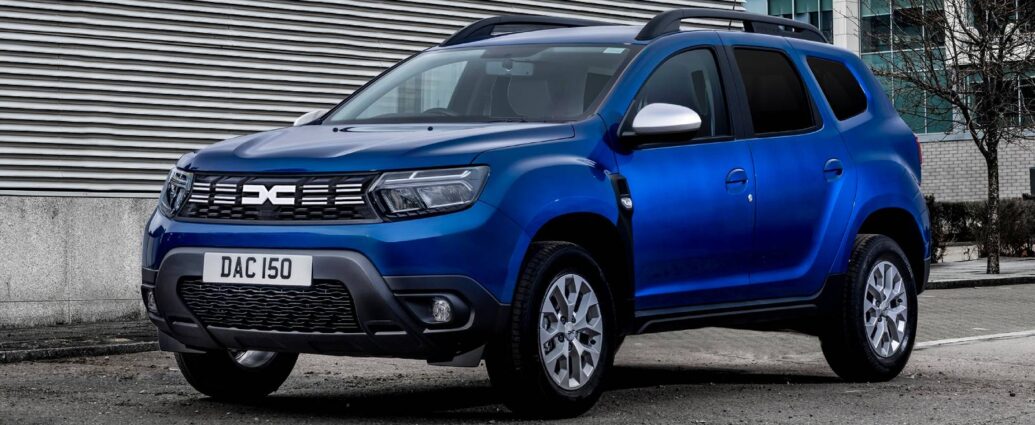
The Dacia Duster Commercial has been given an update, receiving the firm’s latest brand identity and giving it a refreshed look along with a simplified model range.
The Dacia Link emblem — a strong feature of the brand’s new identity — now features front and centre in the middle of the grille, redesigned and presented in white. Like the links of a chain, the interlocking ‘D’ and ‘C’ of the emblem reflect the ‘robust simplicity’ of the new design, accentuated by new Y-shaped LED running lights. The new logo also appears on the vehicle’s rear panel and steering wheel.
The flared wheel-arches remain, matched with durable skid plates, front and rear, that emphasise the Duster Commercial’s rugged roots. Contrasting black roof bars add to the Duster’s practicality, backed up by its 210mm of ground clearance and 450mm wading depth.

Dacia Duster Commercial: The Basics
Based on the Duster SUV, the Commercial is homologated as an N1 commercial version, adding a flat load area that offers up to 1,623 litres of space and a 503kg payload capacity.
Converted at the factory, technicians replace the rear seats of the Duster with a completely flat wooden load floor covered with a hard-wearing surface. A sturdy mesh bulkhead separates the load area from the front passenger compartment, while a series of lashing eyes make it easy to secure loose cargo.
A full-length removable load cover keeps the cargo bay’s contents shielded from prying eyes, aided by an opaque film applied to the fixed rear windows.
The absence of a stepped load sill makes accessing the 1,792mm long load area easy. A load width of 1,247mm and a floor-to-ceiling height on the 4×2 models of 917mm leaves room for reasonably bulky items, too.

Dacia Duster Commercial: Powertrains
The Duster’s update doesn’t extend to engines, which remain as before. This means a choice of proven petrol and diesel engines with outputs from 90hp to 150hp, with a choice of two- or four-wheel-drive. A six-speed manual transmission is fitted as standard, with a six-speed automatic available with the TCe 150 engine.
Two petrol options are available, starting with the turbocharged three-cylinder 1.0-litre TCe 90, delivering 90hp and 160Nm of torque. Fuel economy is measured at up to 45.6mpg according to WLTP testing. A more powerful TCe 150 engine provides 150hp. Coupled with a six-speed dual-clutch EDC transmission, performance is improved with a 0-62mph time of 9.7 seconds, yet it returns the same 45.6mpg economy as its lower-powered sibling.
A 115hp diesel model, the Blue dCi 115, is available with either two- or four-wheel-drive. The front-wheel-drive model offers fuel economy of 57.6mpg and CO2 emissions of just 127g/km. Opt for the off-road capable 4×4 version and economy drops slightly to 53.3mpg with CO2 emissions rising to 139g/km.

Dacia Duster Commercial: Simplified Range
Dacia has simplified the Duster Commercial range, cutting it down to two distinct trim levels. The Essential grade features 16-inch steel wheels, air conditioning, electric front windows, cruise control with speed limiter, seven-function on-board computer, height- and reach-adjustable steering wheel with backlit controls, DAB radio with Bluetooth connectivity and a USB connection.
The higher-specification Expression grade adds 16-inch alloy wheels, front fog lights, heated and electrically adjustable door mirrors, a rearview camera with parking sensors, and a centre differential lock on 4×4 models. The interior gains upgraded upholstery, a leather steering wheel, a centre console with a driver’s armrest, and an 8.0-inch infotainment screen with both Android Auto and Apple CarPlay.
Dacia Duster Commercial: Pricing and Availability
The updated Dacia Duster Commercial starts at £13,995 excluding VAT. That gets a front-wheel drive Essential model with the TCe 90 petrol engine. At the other end of the range, a Blue dCi 115 4×4 in Expression trim comes in at £18,795 before VAT and delivery costs.
First deliveries are due in the last quarter of 2022.
- Pickup registrations fall for 10th month as tax changes hit market
- Toyota adds commercial two-seat Hilux conversion
- Chery invests $75m in KGM as Korean manufacturer expands Chinese technology partnerships

- CTEK CS One Gen 2 review: Smart charging to keep your pickup’s battery in top condition
- Ford built a 420hp V8 Ranger and then kept it to itself

- Pickup registrations fall for 10th month as tax changes hit market - 10 August 2026
- Toyota adds commercial two-seat Hilux conversion - 10 August 2026
- Chery invests $75m in KGM as Korean manufacturer expands Chinese technology partnerships - 3 August 2026