
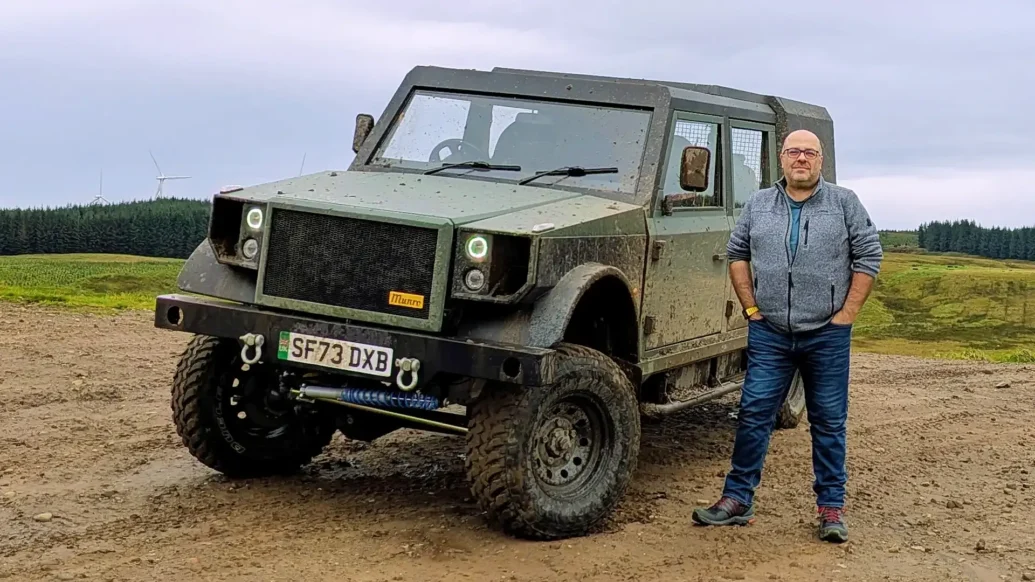
The Munro Series M doesn’t pretend to be an SUV. It doesn’t have soft-touch plastics, a glossy touchscreen dashboard, or a badge engineered to make you feel special. It’s a tool, and one that just happens to be electric. Built in Scotland and designed for forestry, utilities, mining and rescue work, this all-electric 4×4 promises zero-emission capability where no other EV dares go.
We’ve driven the latest pre-production version on the brutal terrain of Drumclog Off-Road Centre , and it’s safe to say the Munro is epic off-road — and just about acceptable on-road.
Pros
+ Exceptional off-road capability
+ Built for longevity and repairability
+ Purpose-built electric drivetrain
Cons
– Agricultural on-road manners
– High upfront cost
– Limited refinement and tech
Munro Series M design and engineering
At first glance, the Munro looks like it’s been hewn from the same granite as the Scottish hills it’s designed to conquer. Flat aluminium body panels, exposed fixings, and a scratch-resistant finish create a utilitarian aesthetic that makes a Land Rover Defender look like a city SUV. There’s nothing unnecessary, nothing here that doesn’t serve a purpose.

Underneath, it’s just as serious. A heavy-duty ladder-frame chassis supports coil-sprung live axles and full underbody protection. Ground clearance stands at an astonishing 480mm at the centre point of the vehicle — it drops to 280mm at the lowest point, but that’s still 50mm more than a Ford Ranger provides — while approach, departure and breakover angles of 84°, 51° and 148° respectively mean there’s little on earth this can’t climb, descend, straddle, or conquer.
Power comes from a single electric motor mounted centrally in the chassis, linked to a traditional two-speed transfer box and a permanent four-wheel-drive system. There are two versions: the M170 produces 231hp and 600Nm of torque, while the M280 ups that to 381hp and 700Nm. Both use an 85kWh lithium iron phosphate (LFP) battery chosen for its stability, resistance to temperature extremes, and lack of rare-earth cobalt.
It’s an unashamedly industrial setup, designed for the long haul. Munro expects each vehicle to last 20 years with straightforward servicing and simple component replacements — a philosophy that sets it apart from the increasingly disposable nature of modern 4x4s.

Cab and interior
Step inside and you’ll find no illusions about this being a lifestyle vehicle. The cabin is deliberately functional, with exposed metal, billet aluminium door pulls and rubberised flooring that can be hosed down after a muddy shift. Heated leather seats come as standard, but that’s about as luxurious as it gets.
Instrumentation is basic — there’s just a small screen showing speed and range — backed up by large, glove-friendly rocker switches. There’s still some tech, though, as Android Auto and Apple CarPlay are included on a compact central display that doubles as a display for the reversing camera.
Munro’s focus on durability extends to every control, which feels solid, tactile and easy to fix should it ever break.
Despite, or thanks to, the simplicity, there’s space for five adults and a generous 1,600 litres of load volume in the Utility model. The layout can also be customised, from crew cabs and chassis cabs to bespoke bodies for forestry or utility use.

At home on the road?
On tarmac, the Munro feels every bit as agricultural as its looks suggest. There’s more than a fair amount of wind noise, the chunky off-road tyres make a racket against the road, the steering takes some time to settle into a straight line, and the suspension floats and dives like a vehicle built for ruts rather than roundabouts.
If you’re comparing it to a modern Defender, prepare for disappointment. But judged against its mission, it’s absolutely fine. Drive it as you would a classic Defender, in a measured, deliberate, and unhurried manner, and it’s comfortable enough. You certainly wouldn’t be looking for excuses to avoid a drive.

The electric drivetrain helps enormously. With no gear changes clunking through the chassis, it’s surprisingly easy to drive in traffic. And the absence of diesel clatter makes the experience more refined than it has any right to be, even as the rough edges remind you that this is a serious piece of equipment, not a commuter crossover.
Unstoppable off road
Take the Munro off-road, and it transforms from a slightly agricultural curiosity into something genuinely impressive. This is where its design philosophy makes perfect sense.
The combination of enormous ground clearance, solid axles with huge articulation, and the instant torque delivery of the electric motor gives the Munro a level of control that’s difficult to match with a conventional diesel 4×4. Instead of building revs and slipping a clutch, or waiting for an automatic gearbox to catch up, the motor smoothly and precisely feeds in torque, allowing the vehicle to crawl forward almost silently.
At low speeds, the drivetrain feels deliberate. With the two-speed transfer case in low range, the Munro will climb steep obstacles without breaking a sweat, the motor delivering power in a perfectly linear stream. There’s no turbo lag, no gear changes and no drivetrain shock — just steady, controlled progress.

Our test route at Drumclog was designed to expose weaknesses. Deep mud, steep climbs, off-camber tracks, soft and wet grass hillocks, and rocky steps all feature heavily here, and most modern SUVs will struggle before they’ve even reached the halfway point. Even experienced off-roaders are advised to avoid certain areas.
The Munro, however, simply gets on with it.
Approach angles that look almost cartoonishly steep on paper prove very real in practice. Obstacles that would threaten the bumpers of most 4x4s are dispatched without drama, thanks to the vehicle’s tall stance and short overhangs, which allow it to climb and descend slopes with remarkable ease.
Axle articulation is impressive, with the live axles working hard beneath the ladder frame chassis. The Munro keeps its wheels planted even as the terrain twists and drops away underneath it, with the optional locking differentials adding another layer of capability, and ensuring power continues to reach the ground even when traction becomes marginal.


If there’s one moment where physics reminds you of the vehicle’s size and weight, it’s on steep descents. The Munro is not a lightweight machine, and gravity still plays its part when heading downhill. But with careful braking and low-range engaged, it remains composed and predictable.
Only one obstacle beat us, and that was a steep drop between two rocky cliff faces. Even then, I’d have made it through if I had been prepared to hand the car back with some minor bodywork alterations. It might be just 1812mm wide — that’s narrower than a Ford Focus — but some gaps are just too small!
What’s striking throughout the experience is how simple everything feels. There are no complicated terrain modes or endless menus to scroll through. Instead, Munro relies on old-school mechanical engineering like solid axles, lockers, and low range, combined with the precise torque control of an electric motor.

The result is a vehicle that feels honest and immensely capable. Rather than dazzling you with technology, it simply goes wherever you point it.
Munro Series M practicality and payload
The Munro’s numbers tell their own story. Payload is up to 1,000kg, and towing capacity peaks at 3,500kg. So far, so conventional. The flat-sided body makes it easy to mount equipment or add bodywork, though, while the 4.59m length and 1.81m width (roughly 75cm shorter and 10cm narrower than a Ranger) mean it still fits through farm gates and along narrow forestry tracks. There’s almost nowhere it can’t go.
And when you do get it somewhere, and it needs work, everything about the Munro is designed for field serviceability. Panels unbolt easily, electrical systems are accessible, and even the battery packs are modular and replaceable. Operators can carry out most maintenance on-site without voiding the warranty, provided it’s inspected annually by Munro or an approved technician. To really hammer home that point, Munro will come and train your own technicians. If you’re working on a secure site on a remote island, then that’s a huge benefit.

Being an EV, operational emissions drop to zero, and, for remote locations, it can be charged from solar or on-site renewables rather than having diesel trucked in, which helps to reduce costs and complexity. By how much? Munro reckons running costs are up to 60% lower than an equivalent diesel pickup.
Costs and charging
Prices start from £69,662 (ex VAT) for the M170 Utility, and £82,495 for the more powerful M280. That’s expensive on paper, but Munro insists it’s a long-term investment. With a 20-year service life, minimal maintenance, and around 4.5 tonnes of CO₂ saved annually compared with a diesel equivalent, the maths makes sense for operators who keep vehicles for the long haul. You’ll need to get your accountant to do the maths and see if it works for your business.
Charging is straightforward. The M-Series supports 130kW DC charging, topping up from 15–80% in about 30 minutes. AC charging is capped at 7kW, taking around 12 hours on a standard wallbox. Range is officially 170 miles on road or up to 16 hours of off-road use — more than enough for a day’s hard graft.
Munro Series M: The Professional Van verdict
The Munro is not trying to be all things to all people. It’s not refined, stylish or cheap, but it’s a genuine working tool that delivers something no other EV does right now — really serious off-road capability with zero tailpipe emissions.
It’s proof that small, focused engineering can still thrive in a world dominated by global brands. For operators who need to reach the remotest parts of Britain or the rest of the world without burning a drop of diesel, or are looking for an apocalypse survival vehicle, this Scottish-built machine is the real deal.

- Pickup registrations fall for 10th month as tax changes hit market - 10 August 2026
- Toyota adds commercial two-seat Hilux conversion - 10 August 2026
- Chery invests $75m in KGM as Korean manufacturer expands Chinese technology partnerships - 3 August 2026