
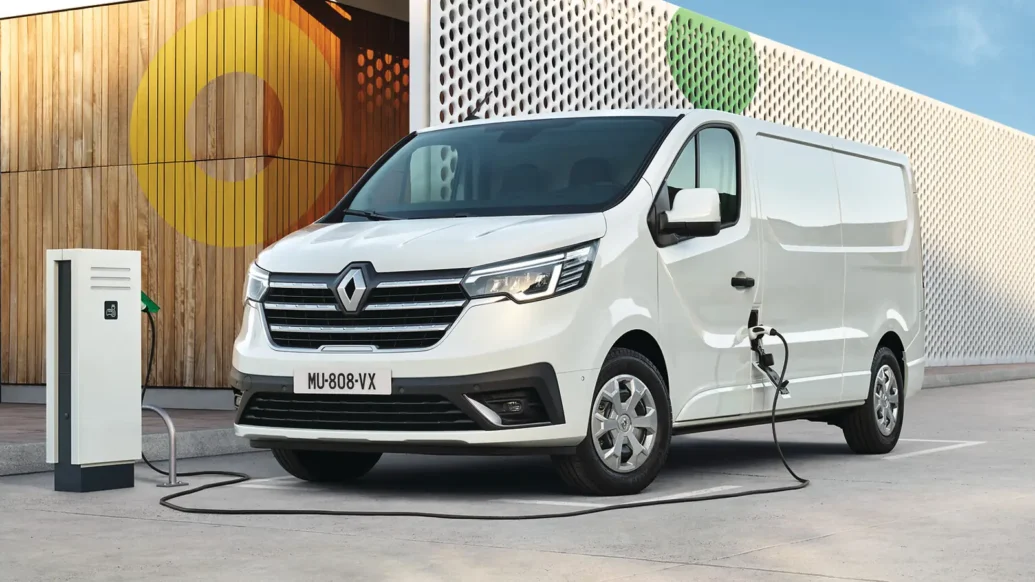
Renault has sold more than 2.4 million of its Trafic van since its introduction in 1980, but this year is the first time you’ll be able to drive an electric version as the French manufacturer extends its E-Tech all-electric technology from the smaller Kangoo and larger Master to the medium-sized LCV.
Renault promises no corners have been cut in the transition from diesel to electric power, with the Trafic E-Tech Electric offering a ‘high level of performance along with ample choice and customisation possibilities’.
Renault Trafic E-Tech: Payload and Practicality
The van is available in two body lengths (5.08 and 5.48 metres) and two heights, ranging from 1,967mm to 2,498mm, giving a cargo volume between 5.8m3 and 8.9m3. In the L2 van, items up to 4.15 metres in length can be stored, thanks to a ‘trap door’ in the bulkhead that extends the loading area into the cabin’s passenger side. The maximum payload capacity stands at 1.1 tonnes, with a towing limit of 750kg.
The cab storage space totals 88 litres, with 19.7 litres in the centre console, 14.6 litres within the doors, and 54 litres beneath the bench. Some models feature an Easylife drawer instead of the glovebox, which slides out for the driver’s convenience and holds 6.6 litres.
The Trafic van was the first LCV to come with a “mobile office”, a system where the back of the centre seat becomes a desk when folded down. That now ubiquitous facility continues with the Trafic E-Tech.

Renault Trafic E-Tech: Electric Range and Recharging
The Trafic E-Tech is equipped with a 52kWh battery pack, offering a range of 184 miles, according to official WLTP figures. The batteries provide power to the electric motor, which produces 122hp and 245Nm of torque.
Various drive modes help extend the van’s potential range, with a ‘long range’ version limited to 56mph giving a maximum range of 200 miles. Adaptive regenerative braking also helps to capture wasted energy when slowing, further enhancing the vehicle’s efficiency.
Charging might pose challenges for some. The Trafic E-Tech supports 7kW home (or depot) chargers and 22kW public fast chargers. Using the latter, a charge from 20% to 80% will require almost an hour and a half.
A swifter 50kW charging option is slated for 2024, reducing that charge time to roughly 40 minutes. However, this remains notably slower than competitors — the Vauxhall Vivaro Electric achieves a similar charge in under 20 minutes, while the Ford E-Transit is faster still.

Renault Trafic E-Tech: Price and Availability
While Renault has yet to disclose pricing details, it’s worth noting that the larger Master E-Tech panel van is priced approximately £18,000 higher than its diesel counterpart before any government grants.
Order books for the longer L2 panel van, crew cab, and platform cab models will open in October, with deliveries commencing in November. The more compact L1 models are scheduled for release a month later.

- Renault Niagara pickup revealed, but it’s only for Latin America - 10 September 2026
- Mitsubishi L200 Commercial swaps rear seats for van tax treatment - 10 September 2026
- Volkswagen launches blacked-out Amarok Dark Label pickup - 9 September 2026