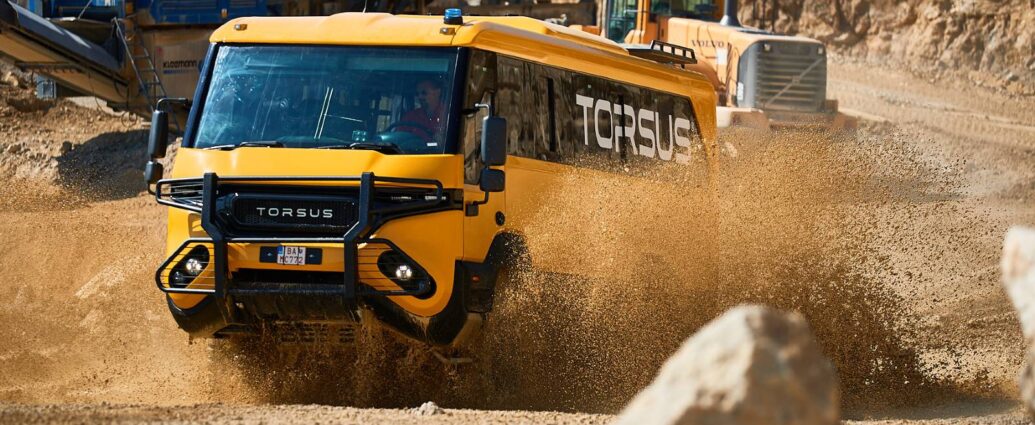
Torsus builds heavy-duty, off-road capable buses and vans, but that undersells their capabilities. The Praetorian model, for example, is a 4×4 off-road bus that will transport people across some of the world’s most challenging terrain, even seeing service in the Ukraine-Russia conflict. But who would build such a niche model, and why? Vakhtang Dzukashvili, CEO of Torsus, sat down with Professional Van to discuss his company’s journey, its innovative vehicles, and future plans.
Dzukashvili began his career in fleet sales for Ford in Ukraine before co-founding Pulsar Expo with his wife, Yuliya Khomych, supplying vehicles for technical aid programs. That experience led to the creation of Torsus.
“We realised what was missing in different parts of the world with poor infrastructure and hard-to-reach areas,” explained Dzukashvili. “We found an opportunity to satisfy a demand and create vehicles to transport people and cargo in the world’s harshest environments.
“We set to work to design our own off-road bus and incorporate everything we believe our customers would like in their ideal vehicle, with a huge emphasis on quality and building the very best. However, whilst this was going on, the war between Ukraine and Russia broke out, and we discovered a greater demand for off-road buses.
“We noticed, alongside this, industries such as mining, adventure tourism, emergency services and other similar fields all required off-road buses. Whilst it appears to be a very niche vehicle on the face of it, it actually serves a purpose in many industries worldwide, and that’s why we proceeded with building the Torsus Praetorian — our first vehicle, following the launch of Torsus in 2017 .”
.”

Despite being a niche vehicle, the Torsus Praetorian is more cost-effective and capable of transporting more personnel than owning a fleet of SUVs or pickups, and that’s attracting larger customers.
“B2G (Business to Government) and B2B (Business to Business) are the majority of our sales, whilst a very small portion comes from direct sales to end users. The main industries we focus on are oil and gas, tourism and law enforcement.
Torsus is represented and distributes to four continents (Europe, Central Africa, Australia and South America) currently selling in multiple markets (Germany, Poland, Australia, Papua New Guinea, Gabon, Chile, Peru and Ukraine). Torsus is able to export to any country except the US (due to other standards) and countries that are on the UN restriction list.”

Torsus recently introduced an evolution of its products with the Terrastorm. This is a smaller, heavy-duty off-road commercial vehicle capable of carrying up to 20 passengers, compared to the 37 of the Praetorian.
“We actually tasked our engineers to provide a smaller vehicle than the Praetorian, but without any reduction on durability, and the strength from the suspension, meaning that it needs to offer the same off-road performance. One other significant point to make is that we had to fully design the interior of the vehicle to cater for passengers and to ensure it was perfect for off-road conditions. This included fitting seats with five-point seatbelts and having special rollover protection integrated into the body, allowing the vehicle and its occupants to be prepared for any transportation off-road. Ultimately, the Terrastorm is the best at what it does, and as it’s DNA is from the Volkswagen MAN TGE, it is guaranteed to be reliable and a trusty vehicle for any task thrown its way.”

Interestingly, the Terrastorm doesn’t require an HGV licence or off-road training, making it accessible to a broader range of users.
“The market for Terrastorm is similar to that of the Praetorian in terms of industries, but the Terrastorm can have more usages in a wider variety of conditions globally. The most popular model so far has been the ambulance, and usually, a government, big NGOs, or other similar health organisations will never buy one vehicle; they buy a fleet. I can say the same about law enforcement and emergency relief. Based on these groups of customers, it generates thousands of sales. So, what’s the aim of the Terrastorm? It’s to be the basic vehicle for these groups of customers.
“We currently have a number of configurations available for the Terrastorm — the Coach, Cargo, Mining Site, Medivac or Empty Shell. The Terrastorm Cargo is built to be a panel van inside whilst the Empty Shell is the perfect vehicle for modification into Overlander type vehicles, laboratories, Mobile workshops and other special purpose vehicles.”

Dzukashvili also addressed the company’s expansion plans, expressing an interest in the UK market, highlighting that Torsus tailors its vehicles to industries rather than geographical regions.
“The UK is a huge market. Generally, we never discuss countries when it comes to interest in Torsus vehicles, but industries that are in those countries — if a vehicle is perfect for the mining industry in one region, we know it will be ideal for any other mining area anywhere else the world due to similar processes and tasks that the industry undertakes.”
In the wake of environmental concerns and proposals to ban diesel vehicles in the UK and elsewhere, Dzukashvili confirmed that Torsus is open to integrating electric or hybrid solutions into their vehicles, in cooperation with their partners, such as MAN.
“We are in deep, deep cooperation with MAN, who helped develop the Praetorian, and they are fully aware of the UK’s proposal to ban diesel-powered vehicles in under ten years. Working with MAN, when we know there’s an electric or hybrid solution, which also works well for Torsus, then we are happy to integrate this into our vehicles. We have had requests from industries where driving through environments needs to be as quiet as possible, as well as clean as possible. We are definitely looking into it.”
Dzukashvili says Torsus has no plans to enter the pickup truck market, and believes that the company’s strength lies in the off-road bus market, saying: “The pickup was never really something of interest to us, and to make it to the level of quality and high standards that we maintain with our buses would be very difficult, as it would take up a lot of time, effort and money. Furthermore, to stand out in a market with the likes of the Ford Ranger Raptor and Isuzu D-Max AT35 would be very difficult.”
Despite the challenges, Dzukashvili is confident in the future of Torsus. He concluded, “We don’t intend for Torsus to do everything alone – my ambition is to make the best vehicle possible. My attention is to develop a deeper integration and cooperation with both MAN and Volkswagen.” Torsus, in this light, isn’t merely a company that modifies existing vehicles but an OEM (original equipment manufacturer) in its own right.
- Renault Niagara pickup revealed, but it’s only for Latin America

- Mitsubishi L200 Commercial swaps rear seats for van tax treatment
- Volkswagen launches blacked-out Amarok Dark Label pickup
- Pickup market plunges to lowest level since Covid lockdown
- KGM appoints Mertrux as new Derby dealer

- Renault Niagara pickup revealed, but it’s only for Latin America - 10 September 2026
- Mitsubishi L200 Commercial swaps rear seats for van tax treatment - 10 September 2026
- Volkswagen launches blacked-out Amarok Dark Label pickup - 9 September 2026