
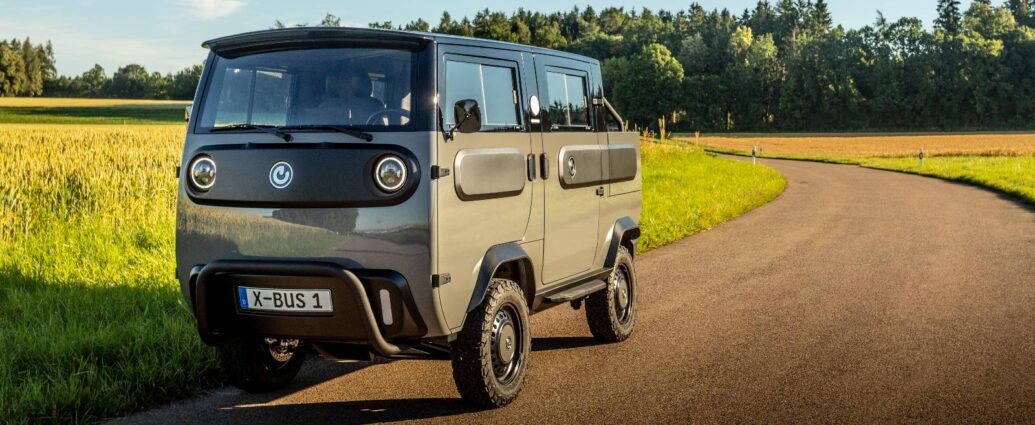
The future all-electric XBUS is getting closer to reality with the presentation of the series-ready prototype. “The time is ripe for the XBUS,” says Ralf Haller, founder of ElectricBrands AG, the company behind the super-compact van.
XBUS: What is it?
The XBUS is a heavy quadricycle, meeting the requirements of the L7e-B2 vehicle class . In English, that means it’s an electrically-powered side-by-side buggy that weighs less than 600kg, has a maximum power output of 76hp, and has a top speed of 62mph.
Designed in a modular form, the XBUS can transform from a compact van to a pickup or tipper. For those wanting to use it for leisure, there will also be a campervan or convertible option.
Two chassis options will be available, with a regular on-road ‘City’ version joined by an off-road package benefitting from a raised ride height and ground clearance.
Working with German suppliers, using environmentally friendly production methods and short delivery routes along with cobalt-free batteries, the lightweight XBUS is climate neutral after less than 6,500 miles on the road. And when its end does eventually come, 98% of its parts can be reused.

XBUS: Electric Drivetrain
The four in-hub motors look to 48-volt technology and boast a combined maximum continuous output of 20hp in line with legislation. However, the torque of over 1,000Nm combined, plus peak power of 76hp, demonstrates that there is always enough power.
Low energy consumption of between 6.2 and 12.4 miles per kWh minimises range anxiety. The basic version, with eight battery packs totalling 10kWh, can achieve a range of up to 125 miles. Those opting for the XBUS with integrated solar cells in the roof can double the available range, assuming the weather plays along. Recharging the XBUS using a three-pin socket at home will take around three hours, but using an 11kW Type 2 charger reduces this to under an hour.
The XBUS can be equipped (even retroactively) with additional battery packs. There is room for 24 battery packs which, combined with solar power from the roof, extend the urban range to as much as 370 miles.
The battery packs can be swapped at stops along your route for rapid refreshing of power. This process takes about as much time as refuelling a combustion engine – and you’re ready to go.

XBUS: Modular Variants
While the ‘Bus’ variant is the headline-grabbing model, there’s doubt that this will be available in the UK. As a side-by-side buggy, legislation limits the vehicle to three non-straddle seats, of which two (including the driver’s seat) must be positioned side-by-side.
The CargoBox model is an ideal companion for covering last-mile deliveries. Able to carry two Euro pallets, the CargoBox model can be adapted and developed for fleet customers. Shaped like the Bus and with the advantage of two side doors plus a large tailgate, the Universal van will work for tradespeople and other light industry users.
Two pickup models will be available, one with a double cab and compact cargo deck or a single cab with a larger box. Adding an optional module turns the XBUS into a tipper aimed at anyone needing to shift lots of material at work.
Leisure users can enjoy the Camper, a small campervan for two. The pop-up roof offers full standing height, with a refrigerator, TV, stove, fresh water tank, sink and a spacious sleeping area all onboard. The Open model is a convertible variant, where the roof can be opened and the rear window removed.

XBUS: Cargo and Payload
Despite its tiny dimensions – the XBUS is just 3.96m long and 1.64m wide – it can accommodate a payload of up to a tonne. The diminutive model can also take a pair of Euro pallets on board at its largest configuration.
XBUS: Pricing and Availability
The starting price for the basic version of the XBUS is expected to be around £17,000 plus VAT. Future production of the XBUS is scheduled to start in the middle of 2022.
- Renault Niagara pickup revealed, but it’s only for Latin America

- Mitsubishi L200 Commercial swaps rear seats for van tax treatment
- Volkswagen launches blacked-out Amarok Dark Label pickup
- Pickup market plunges to lowest level since Covid lockdown
- KGM appoints Mertrux as new Derby dealer


- Renault Niagara pickup revealed, but it’s only for Latin America - 10 September 2026
- Mitsubishi L200 Commercial swaps rear seats for van tax treatment - 10 September 2026
- Volkswagen launches blacked-out Amarok Dark Label pickup - 9 September 2026