
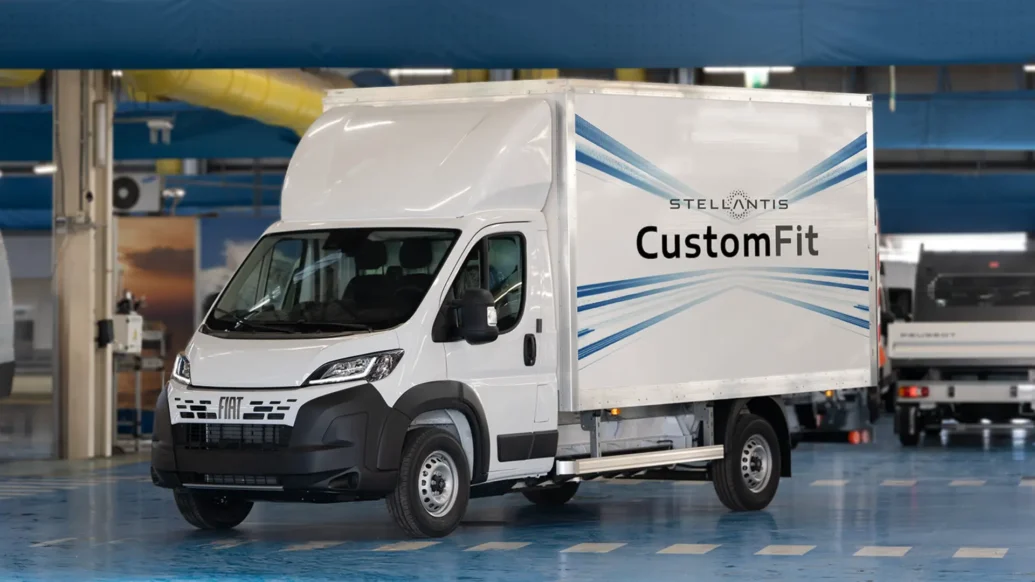
Stellantis Pro One has confirmed the start of production of its new Cargo Box BEV at the Atessa plant in Italy, expanding its large electric van range with a factory-integrated, high-volume electric load carrier aimed squarely at professional users.
Built at Atessa’s CustomFit Centre, the Cargo Box is based on Stellantis’ battery-electric chassis cab platform, which underpins the Citroen Relay, Fiat Ducato, Peugeot Boxer and Vauxhall Movano. Rather than relying on third-party bodybuilders, the Cargo Box is assembled as part of Stellantis’ factory process, aiming to improve consistency, quality, and lead times for businesses ordering ready-to-work vehicles.

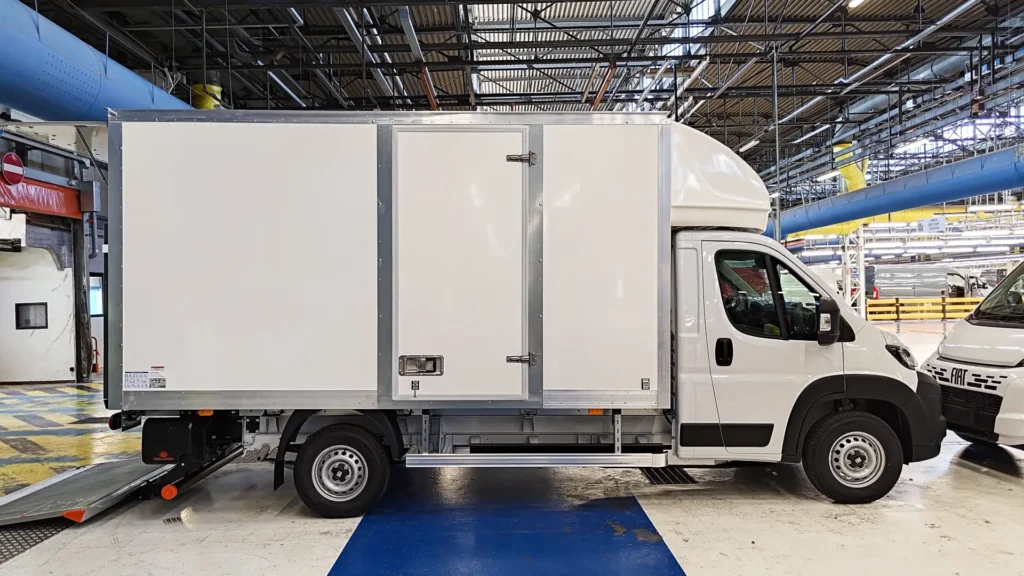
In standard form, the Cargo Box offers a load volume of 18.3m³, with internal dimensions of 4,230mm in length, 2,032mm in width and 2,150mm in height — larger than even the L4H3 version of the standard panel van. For operators requiring additional capacity, an L4 version will also be available, increasing load volume to 20.5m³ thanks to a longer 4,500mm load length and a taller 2,300mm body.
Power comes from Stellantis’ latest large-van electric drivetrain, producing 410 Nm of torque and up to 200kW (270hp), paired with a 110 kWh battery. The manufacturer quotes a driving range of up to 200 miles, depending on specification and operating conditions.
Moving conversions onto the production line
During a visit to the Atessa plant, Professional Van watched Cargo Box bodies being fitted directly to electric chassis cabs on the CustomFit production line. The process was handled by a two-person team, with the box aligned and lowered onto the chassis as part of the main flow, rather than being added later by an external converter.

The process is clearly designed to be repeatable and scalable, reinforcing Stellantis’ push towards factory-integrated conversions rather than post-production modifications.
That approach is intended to reduce build variability and simplify ordering for customers, particularly fleets and SMEs looking for predictable lead times and a single point of responsibility for vehicle specification and warranty.
Faster charging for working fleets
Alongside the launch of the Cargo Box BEV, Stellantis has introduced 22 kW AC charging across its large electric van range. The upgrade halves charging time compared with the previous 11 kW system — when connected to a suitable charger — allowing a full recharge in around six hours and making overnight depot charging more practical for working operators.
For businesses running electric vans on fixed routes or tight schedules, the move to faster AC charging is likely to be as significant as headline range figures, albeit with a need to invest in suitable three-phase AC chargers.
A shifting balance for standard conversions
Stellantis positions its CustomFit programme as complementary to its wider network of independent conversion partners, rather than a replacement. However, bringing high-volume, repeatable conversions such as box bodies in-house is likely to shift some traditionally outsourced work back into the factory.
For customers, factory-built solutions offer clear advantages in terms of warranty alignment, ordering simplicity and delivery times. More bespoke or niche builds are still likely to remain with specialist converters, but OEM-led production of standardised bodies inevitably applies pressure at the volume end of the market.
It’s a tension that will be familiar across the commercial vehicle sector as manufacturers look to tighten control over specification, quality, and time-to-market.

Anne Abboud, Head of the Stellantis Pro One division, said the start of Cargo Box BEV production underlined the group’s focus on combining electric drivetrains with high-capacity, task-specific body styles designed to meet the needs of professional customers.
The Cargo Box BEV will be offered across Stellantis’ large van brands, with UK pricing and availability to be confirmed in due course.
