
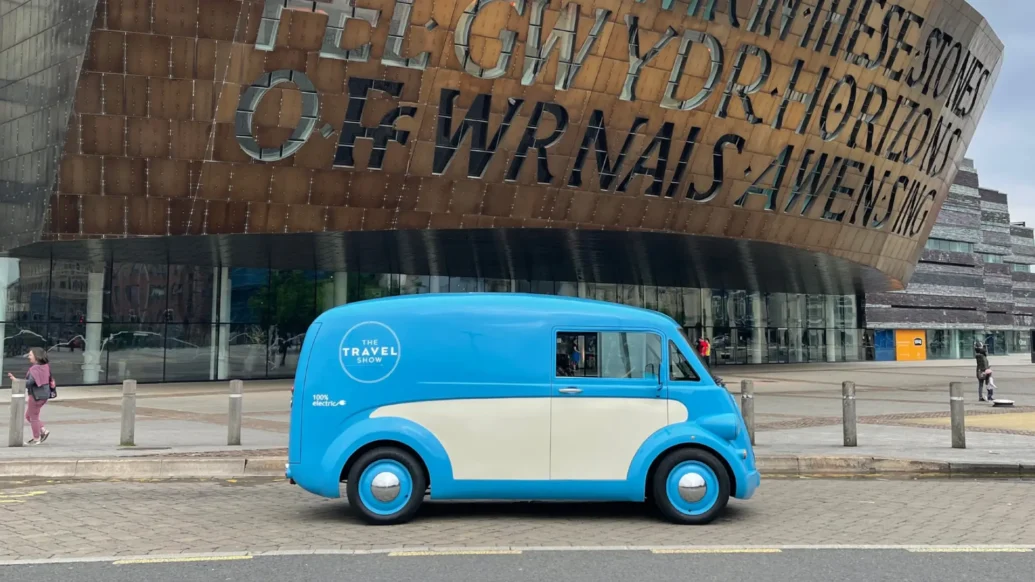
Morris Commercial’s long-promised electric revival of the 1950s Morris J-Type has taken a significant step forward, with the company confirming that production of the new Morris JE van will begin in Wales in late 2026. The van will be built at Bro Tathan in the Vale of Glamorgan, supported by Welsh Government investment, with the project expected to create around 150 skilled jobs.
The announcement marks the most concrete progress the JE has made since the retro-styled EV was first unveiled in 2019. At that point, Morris claimed production would start in 2021. A revised 2024 target later came and went, but the company now says its engineering and certification programme is nearing completion and that manufacturing will begin in Wales next year.
Wales secures its first electric vehicle factory
Bro Tathan will become Wales’ first dedicated EV manufacturing site. The Welsh Government’s Economy Futures Fund is providing financial support for the project, which officials say fits into a wider effort to develop a low-carbon automotive supply chain in the country.
Rebecca Evans, Cabinet Secretary for Economy, Energy and Planning, called the JE “a natural fit” for Wales, describing the project as “an exciting opportunity” that will create well-paid, skilled jobs.
Morris Commercial CEO Dr Qu Li said the new facility would allow the company to “start to deliver vehicles to long waited [sic] customers”.
Morris JE: A niche retro eLCV
The Morris JE is a modern reinterpretation of the 1950s J-Type, complete with its distinctive pear-shaped grille, but underneath sits a very different machine.

The company is sticking with its original lightweight concept, which means a 1,000kg payload in a 2,500kg GVW van, with 6.6m³ load volume — a number that’s grown twice since the original reveal, which detailed a 5.5m³ capacity.
An aluminium skateboard chassis will underpin the van, with carbon-fibre bodywork now confirmed to be made from recycled material.
Morris is targeting a range of 250 miles from a full charge, with rapid charging to 80% in around 30 minutes, which we assume means it’s sticking with its original 60kWh battery pack.
Premium pricing for a premium niche
Morris has long positioned the JE as a premium, design-led EV aimed at boutique businesses and brands wanting something distinctive — an area that Volkswagen targets with its ID Buzz Cargo.
The company now quotes a starting price of £61,000, with build-slot reservations due to open closer to launch. A £5,000 plug-in grant is expected to apply, with the government confirming that the grant will remain in place until at least 2027.
Morris says full production in Wales will begin in late 2026, with a ramp-up period of around 12 months. The company aims to build more than 1,000 units per year, focusing on low-volume, high-craftsmanship output rather than mass production.

Two further derivatives — a pickup and a minibus — are planned to follow once van deliveries begin.
Morris JE: A long way from 2019
The JE story began in 2019, when the company unveiled a concept at the Design Museum in London, promising a 200-mile range, carbon-fibre construction, and a 2021 on-sale date. Pre-orders were opened, prototypes were showcased at industry events, and early interest was strong.
But manufacturing, funding, and supply chain challenges repeatedly pushed the project back. A planned production facility in Worcestershire never materialised, and a 2024 launch target was also missed.
The move to Bro Tathan is the first time a firm production site, Government backing and a detailed timeline have aligned, making the 2026 date the most credible yet.
The Morris JE won’t replace mainstream electric vans like the Ford E-Transit Custom or Vauxhall Vivaro Electric, nor is it intended to. Instead, it’s a niche, visually distinctive and relatively lightweight option likely to appeal to hospitality operators, mobile retailers, premium brands and businesses that value the van’s design as much as its utility.
However, with the Volkswagen ID Buzz struggling to appeal to buyers in that market, leading to production being suspended, and Kia’s arrival with its distinctive and aggressively priced PV5, Morris is facing a far more difficult landscape than it did in 2019.

- Renault Niagara pickup revealed, but it’s only for Latin America - 10 September 2026
- Mitsubishi L200 Commercial swaps rear seats for van tax treatment - 10 September 2026
- Volkswagen launches blacked-out Amarok Dark Label pickup - 9 September 2026