
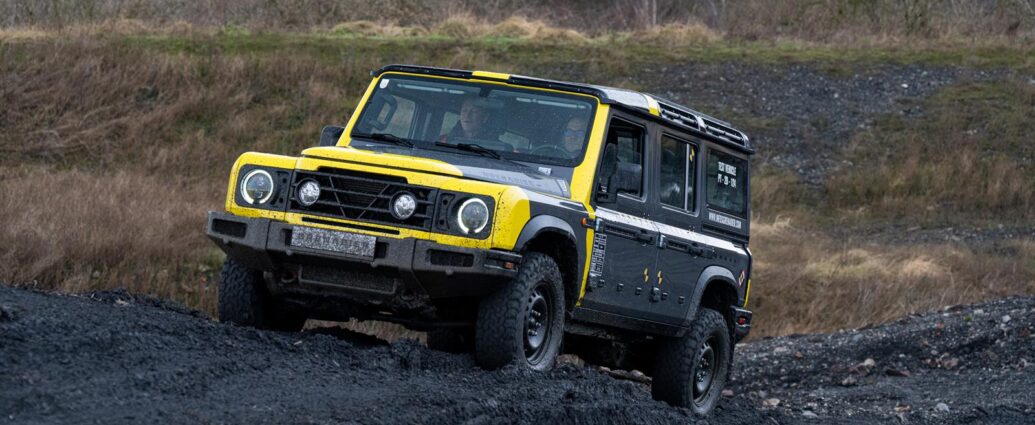
Driving a prototype vehicle rarely tells you a huge amount about the vehicle it will ultimately lead to, but putting a pre-production Ineos Grenadier through some serious off-road testing proved one thing: it feels unstoppable.
Our experience of the Grenadier has been slowly building. We’ve been driven up the Goodwood Hill at the famous Festival of Speed, ridden in the passenger seat while facing rather gentle terrain, poked around the production-ready interior, toured the impressive factory and spent quite a lot of time with many of the team members. There’s been more teasing than you’ll find at a burlesque show but, finally, we’ve been behind the wheel.
The prospect of a full road test in a production model still seems frustratingly distant, but getting an early opportunity to drive the Grenadier, even if it’s in a prototype and limited to tricky off-road terrain, will tell us something, so that’s why we were stood in a long-abandoned mine in the Moselle region of France, suffering freezing cold drizzle and bitter winds.

What’s Underneath?
There’s nothing revolutionary about the Grenadier. Ineos boss, billionaire Sir Jim Ratcliffe, thinks there are enough people in the world who want a no-nonsense utilitarian vehicle like the Grenadier to make it a profitable venture, and has invested a billion or so in making it happen.
But to be rugged and utilitarian, while also being developed for half of what you might expect an automotive giant to spend on a new SUV, it’s relying on proven technology. The chassis is, therefore, a simple ladder frame, the engine and gearbox are borrowed from BMW where they’ve been proven to work for years, and the body has been rather obviously inspired by the functional form of the old Land Rover Defender.

Solid axles with variable load coil springs and dampers promise a compliant ride and impressive axle articulation. The permanent four-wheel-drive system comes with a central locking differential, with electronic locking diffs at both the front and rear available. The 3.0-litre diesel engine, provided by BMW, provides 550Nm of torque to tackle most challenges, and the eight-speed automatic gearbox is the same ZF unit that’s slotted into countless other cars and SUVs . Everything is a known quantity, chosen not just to cut costs and time in development, but to ensure that the Grenadier is reliable, trustworthy and, above all, capable.
What’s It Like Inside?
Our time was spent in a well-used prototype, so the interior was, frankly, barely functioning. The reveal of the Grenadier’s interior back in July 2021 showed what the finished vehicle will look like, and the production prototypes we saw coming off the factory line look and feel much the same.

That means there’s a panel of tough buttons and switches stacked up in the middle. They’re big, chunky and clear, able to be poked and prodded while wearing gloves. The 12.3-inch touchscreen infotainment centre mounted at the top of the dashboard was working this time, with clear and useful graphics showing what the vehicle was doing. Up front is a tiny screen for warning lights and suchlike, leaving a remarkably clear view of the terrain ahead. Still a novelty but an undoubted highlight is the bank of roof-mounted switches to control the differentials, and other ancillaries. Impressively, eight of the switches will be pre-wired for accessories such as external lights, winches or power supplies.
It’s all reassuringly tactile and chunky, although we can’t get over the mismatched gear selector, range selector and handbrake; there’s a modern, intricately shaped plastics device for the gear selector, a simple and tough metal knob for choosing drive ratios, and a classic leather-wrapped traditional handbrake lever. In a cabin pulling off the simple and functional design perfectly, this area jars somewhat.
How Does It Drive?
I’m immediately reminded that this is a prototype, and a heavily used one at that; it’s as cold in the cabin as it is outside as the heating doesn’t work, and there are stickers everywhere remind you that one thing or another doesn’t work (such as the airbags) and that some things need checking (such as whether the bonnet is shut properly.) A large red emergency shut off sits on top of the dashboard, ready to be pressed if things go terribly awry.

Heating aside, once it’s rolling there are few clues that this isn’t the finished product. The steering grinds away as the wheel is turned, the motor offering power assistance clearly suffering some gremlins, but that can be overlooked. Beyond that, it feels rock-solid, as if it’s been pulled straight from the production line.
I’m in the petrol-powered model, so I have a little more power (285hp versus the diesel’s 249hp) and a little less torque (450Nm against 550Nm) but there’s no sensation that the Grenadier is underpowered. It felt plenty quick enough and smooth enough up the Goodwood Hill, where motorway speeds were reached with ease, but the thick, sticky mud we’re facing in France won’t see such velocity.

Instead, we’re in low range with the centre diff locked, occasionally reaching fourth gear but rarely exceeding 20mph. Steep climbs, knee-deep ruts and slippery traverses will test the Grenadier and its off-road prowess, but it won’t strain the engine.
We’re on BFGoodrich All-Terrain T/A tyres, so there’s some extra traction available, but the quagmire we’re in soon clogs up the tread. Despite that, the Ineos tackles everything with little more than the occasional slide. Occasionally there’s more significant throttle required, relying on some wheel slip to keep continuous forward progress, but the chassis-deep mud ultimately doesn’t trouble the vehicle.

The flexibility from the engine, with softened responses to prevent surging forward unexpectedly, and precise steering allows you to plot a specific path, although the surface is doing its best to lead us astray. A small quirk is the two-spoke steering wheel which, thanks to its symmetrical style, is sometimes tricky to keep track of when there’s a lot of steering action going on with little feedback from the mud-clogged wheels. There is a grey marker at the top but that merges with the grey material of the wheel; a bright yellow marker would work well and match the yellow detail on the exterior of our test vehicle.
That large front bumper gathered up some mud at the bottom of a drop – there’ll be hill descent control on the finished product but that’s another thing missing from the prototype. The approach angles are good at 35.5°, while the departure angle is marginally better at 36.1°, but both fall a little short of an air-sprung Land Rover Defender. It’s the same with wading depth, which is 800mm on the Grenadier vs 900mm on the Defender. The Ineos has lower ground clearance too, at 264mm against the Land Rover’s 290mm.

Of course, the Ineos doesn’t have any of that high-tech air suspension. Compare it to the coil-sprung Defender and the Grenadier looks far more convincing.
Convincing is a word that keeps cropping up. There’s absolutely zero doubt about the Grenadier’s off-road capabilities. Yes, there is terrain that will defeat it, but it’s unlikely that many customers will ever face such demands. For commercial users in the UK, it’ll do everything you’d ever likely need it to, and do it remarkably well. It feels unstoppable.
What’s Next?
As much fun as it is to hurl a valuable prototype through off-road terrain that will make the valeting team weep, the Grenadier will ultimately spend most of its time on the tarmac. Riding in one up the 1.2 miles of Goodwood Hill, while useful for a first impression, is no replacement for covering hundreds of miles in a production model.

But the current state of the project bodes well for the finished article. It’s unashamedly utilitarian, but balances that with genuine refinement and an aesthetic that, while not exactly modern, creates a sense of drama by simply being present.
Countless third parties will start producing accessories to bolt onto all sides of the Grenadier, from kit to turn it into a vehicle fit for purpose for your business to blinged-up attention-grabbers from tuning companies.
Ineos expects most buyers to be at the commercial end of the market, and the two-seater N1 van version will appeal to many who miss their old Defender, even at an expected £48,000 inc VAT or so, but it feels capable enough that it might just turn into a fashion piece as well.

Ineos reckons it needs to sell 25,000 a year to be profitable. In the UK, there’ll be a handful of dedicated dealerships, and lots of sales and service outlets in agricultural and farm equipment businesses, which suggests that they know their market well.
When Ineos announced their plan to partially replace the Land Rover Defender, many people, maybe even most, were sceptical. As time goes on, there are fewer reasons to doubt the plan. We won’t be convinced until we’ve driven the finished Grenadier both on- and off-road, but every step towards that day has been positive.
- Renault Niagara pickup revealed, but it’s only for Latin America

- Mitsubishi L200 Commercial swaps rear seats for van tax treatment
- Volkswagen launches blacked-out Amarok Dark Label pickup
- Pickup market plunges to lowest level since Covid lockdown
- KGM appoints Mertrux as new Derby dealer

- Renault Niagara pickup revealed, but it’s only for Latin America - 10 September 2026
- Mitsubishi L200 Commercial swaps rear seats for van tax treatment - 10 September 2026
- Volkswagen launches blacked-out Amarok Dark Label pickup - 9 September 2026