
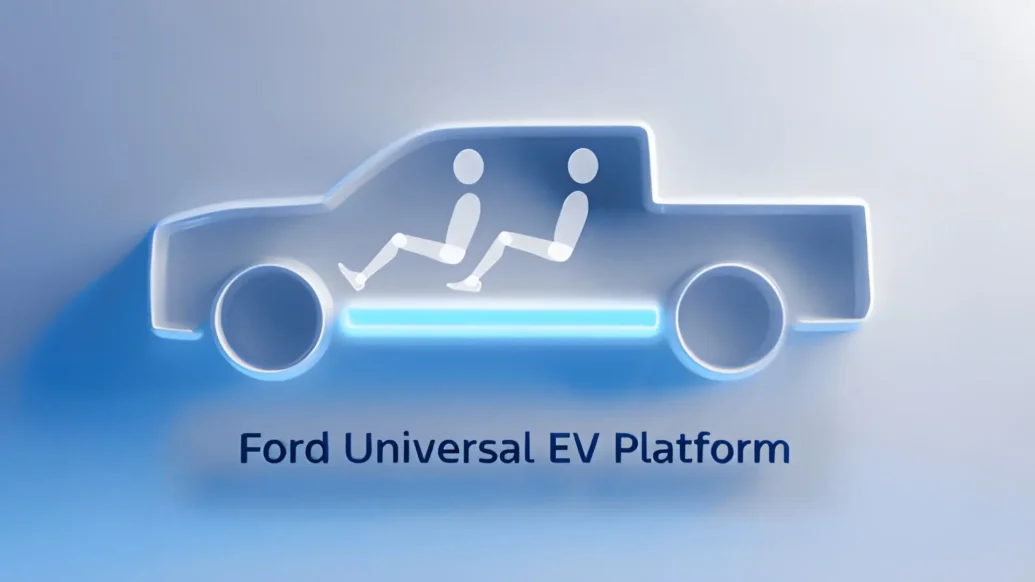
Ford has unveiled a new ‘Universal EV’ electric vehicle platform and production system designed to make building affordable electric pickups and vans viable at scale. The first model to come from the new process, a midsize four-door electric pickup, is expected to arrive in 2027.
At a glance: Ford’s new EV platform and manufacturing process aim to make electric pickups and vans more affordable, durable, and efficient. With promised lower running costs, advanced battery tech, and production at scale, it could bring electric LCVs closer to diesel parity.
The move forms part of a US$5 billion (£3.7bn) investment across the Louisville Assembly Plant in Kentucky and BlueOval Battery Park Michigan, creating or securing nearly 4,000 jobs. Crucially for the commercial sector, Ford says its new Universal EV Platform will underpin a family of electric workhorses that are cost-effective to own, easy to maintain, and built with durability in mind.

Ford Universal EV platform is for work and play
The first product off the line will be a midsize electric pickup aimed at both business and lifestyle users, with a targeted starting price around US$30,000 (£22,100). Ford claims it will offer more usable space than a Toyota RAV4 SUV, a secure load bed, and additional front storage thanks to a frunk under the bonnet.
While Ford hasn’t yet released payload or towing figures, they are expected to be competitive with today’s diesel-powered midsize pickups.
Ford says the new platform reduces parts by 20%, uses 25% fewer fasteners, and cuts assembly time by 15% compared with today’s EVs — efficiencies that should help keep purchase prices down.
The battery technology is also significant. The cobalt- and nickel-free prismatic lithium iron phosphate (LFP) packs double as part of the vehicle’s floor structure, lowering the centre of gravity for better handling, freeing up cabin space, and improving durability. The structural design also means fewer components, reduced weight, and simpler maintenance.
“We took a radical approach to a very hard challenge,” said Ford President and CEO Jim Farley. “Create affordable vehicles that delight customers in every way that matters – design, innovation, flexibility, space, driving pleasure, and cost of ownership – and do it with American workers.”

For operators, Ford is targeting a lower total cost of ownership over five years than a current-generation three-year-old used EV, like a Tesla Model Y, achieved through reduced complexity, lighter wiring looms, and the inherent efficiency of the LFP chemistry. These batteries are less expensive to produce, have a longer cycle life, and maintain performance across a wide temperature range — all key considerations for fleet buyers looking at long-term reliability.
Ford’s EVs will also be software-defined, with over-the-air updates enabling new features, performance tweaks, and diagnostics without a workshop visit, adding another potential cost and downtime saver for businesses.
“We took inspiration from the Model T – the universal car that changed the world,” said Doug Field, Ford’s chief EV, digital and design officer. “We assembled a really brilliant collection of minds across Ford and unleashed them to find new solutions to old problems. We applied first‑principles engineering, pushing to the limits of physics to make it fun to drive and compete on affordability. Our new zonal electric architecture unlocks capabilities the industry has never seen. This isn’t a stripped‑down, old‑school vehicle.”

Rethinking the assembly line
The Ford Universal EV Production System reimagines vehicle manufacturing, replacing the century-old moving assembly line with an “assembly tree” approach. Here, three major subassemblies — the front, the rear, and the structural battery floor — are built separately before being brought together.
For the midsize electric pickup, large single-piece aluminium castings replace dozens of individual parts, improving structural integrity while reducing manufacturing steps. The battery subassembly is fitted out with seats, consoles, and carpets before joining the chassis, streamlining production and reducing operator strain.
This modular build process, Ford says, could cut overall assembly time by up to 40%, with some of those gains reinvested into in-house production and automation to improve quality further.
“We have all lived through far too many ‘good college tries’ by Detroit automakers to make affordable vehicles that ends up with idled plants, layoffs and uncertainty,” added Farley. So, this had to be a strong, sustainable and profitable business. From Day 1, we knew there was no incremental path to success. We empowered a tiny skunkworks team three time zones away from Detroit. We tore up the moving assembly line concept and designed a better one. And we found a path to be the first automaker to make prismatic LFP batteries in the US.”
Investment in US manufacturing
Louisville Assembly Plant will receive nearly US$2 billion (£1.48bn) to prepare for electric pickup production, securing 2,200 jobs. The site will expand by 52,000 square feet, gain upgraded digital infrastructure for faster quality checks, and be optimised for material flow.
Battery production will come from BlueOval Battery Park Michigan, which will build the prismatic LFP packs from next year. The two sites together form the backbone of Ford’s new EV manufacturing strategy.
Implications for the LCV market
While Ford’s initial launch will be a midsize pickup for the US and export markets, the Universal EV Platform’s scalability could make it a strong foundation for future commercial vehicles, including electric vans. The cost, durability, and efficiency gains from the new assembly process and battery tech could finally bring electric LCVs closer to parity with their diesel counterparts, and potentially challenge emerging competitors such as Slate Auto in the affordable EV work vehicle space.

- Renault Niagara pickup revealed, but it’s only for Latin America - 10 September 2026
- Mitsubishi L200 Commercial swaps rear seats for van tax treatment - 10 September 2026
- Volkswagen launches blacked-out Amarok Dark Label pickup - 9 September 2026