
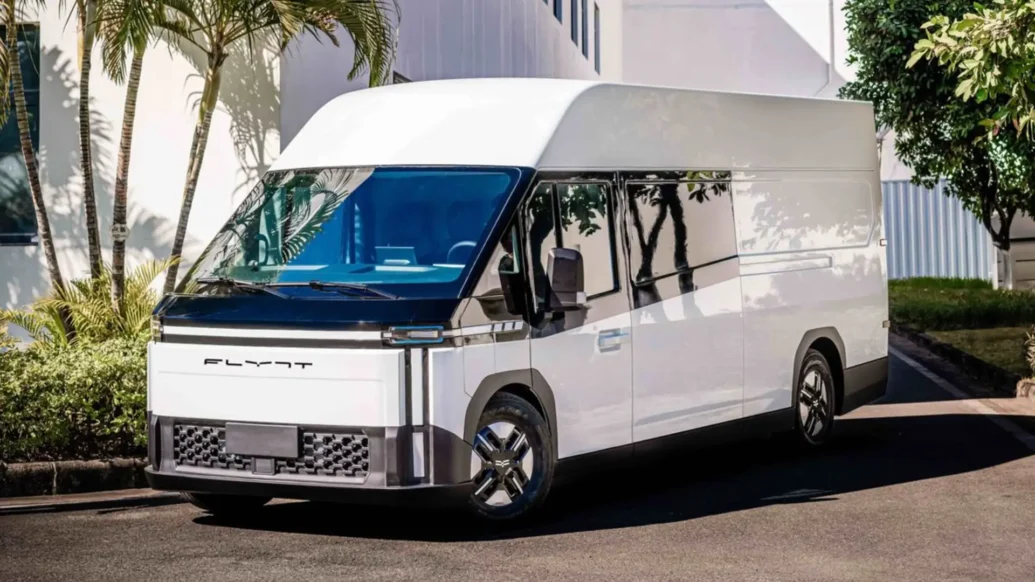
Flynt is a new electric van brand hoping to make waves in Europe by not building its own vehicles. Headquartered in Europe, the brand has revealed its first electric light commercial vehicle (eLCV), developed in partnership with China’s GAC Group and manufactured by its eLCV-focused subsidiary, MiracoMotor.
Flynt says it’s not an OEM in the traditional sense. It doesn’t own a factory, and it doesn’t plan to. Instead, it’s said to be focusing on defining the product, shaping the customer experience, and building a digital-first, pan-European sales and service ecosystem, while outsourcing production and much of the underlying technology.
The vehicle is described as a purpose-built electric van tailored to European fleet needs. It features a 100kWh battery offering a claimed range of up to 310 miles (WLTP) and supports fast charging at up to 220kW, allowing a 30–80% top-up (or another 155 miles of range) in around 20 minutes. Drivetrain options include front-, rear-, and all-wheel drive, built on a native EV platform.
Load space ranges from 8.7m³ to 16.5m³ depending on configuration, with a maximum payload of 1,630kg.
On paper, the figures are competitive. The question is whether Flynt’s unusual business model — blending a European front end with Chinese engineering and outsourced production — can deliver a reliable, cost-effective van.

Not a manufacturer, but a matchmaker
Flynt calls itself an “asset-light OEM”, meaning it isn’t investing in factories or production lines. The company is placing its bet on Chinese EV tech to deliver the goods, literally and figuratively, to European operators.
The approach leans heavily on GAC’s experience in electric vehicle development. GAC is one of China’s largest auto groups, with a significant domestic EV portfolio and growing international ambitions. MiracoMotor, its commercial vehicle spin-off, is providing the platform and manufacturing for Flynt’s van, while Flynt focuses on tailoring the end product to European needs and regulations.
In some respects, this mirrors the kind of global partnerships common in tech manufacturing, but in the commercial vehicle world, questions remain. Will European operators be comfortable with a vehicle designed, built, and supported through such a dispersed network of partners?
Flynt’s founders are unapologetic about their reliance on Chinese EV tech, arguing that it brings benefits in cost, speed, and capability that European manufacturers can’t currently match. They point to China’s lead in battery technology, platform efficiency, and software integration, with features like vehicle-to-grid (V2G), Level 2 autonomous driving, and an 800V architecture promised as standard.

Digital-first for Flynt
Flynt is also positioning itself as a digital-first company. There’s talk of a proprietary platform to manage the customer experience, integrated clean energy offerings, and a reimagined service journey that goes beyond selling vans. While these claims are lofty, the proof will be in the rollout, and as it stands, that’s still some way off.
A prototype has already been previewed to selected media in China, and Flynt says it will arrive in Europe this summer for further testing, pilot schemes, and customer demos. A full market launch is pencilled in for 2026, with a phased rollout planned across 26 European countries thereafter.
Initial distribution agreements have reportedly been signed, though Flynt has not disclosed which markets or partners are involved. The company says it’s still building its partner network, aiming for comprehensive coverage and strong local support — something that has proven challenging even for established players moving into EVs.
Built with, not just for, European fleets?
One of Flynt’s recurring themes is customer co-creation. It claims to have spent 18 months working directly with European fleet operators to shape the vehicle and its feature set.
The vehicle promises modern cabin features, such as a 12.8-inch central screen, wireless Apple CarPlay and Android Auto, and mobile office capabilities. There’s also a heavy emphasis on software-defined vehicle features and digital architecture, which can be an asset, but also a maintenance risk if not backed by robust support infrastructure.
Flynt future
Flynt is entering a fiercely competitive eLCV market, where many legacy players are already rolling out fully electric vans with established support networks and dealer infrastructures. Other newcomers to the LCV market, such as Kia with its PV5 and extended PBV range, are arriving with nationwide dealer networks, strong warranty support and a recognised brand name. To succeed, Flynt must prove that its alternative model, reliant on strategic outsourcing and digital innovation, can match or outperform traditional players on quality, reliability, and uptime.
Flynt expects to begin pilot operations in Europe during the second half of 2025, ahead of its official market launch in 2026. No pricing details have been released yet, and key information such as warranty, servicing plans, or aftersales support remains to be confirmed.
For now, Flynt’s debut is more of a statement of intent than a finished offer.

- Mitsubishi L200 Commercial swaps rear seats for van tax treatment - 10 September 2026
- Volkswagen launches blacked-out Amarok Dark Label pickup - 9 September 2026
- Pickup market plunges to lowest level since Covid lockdown - 8 September 2026