
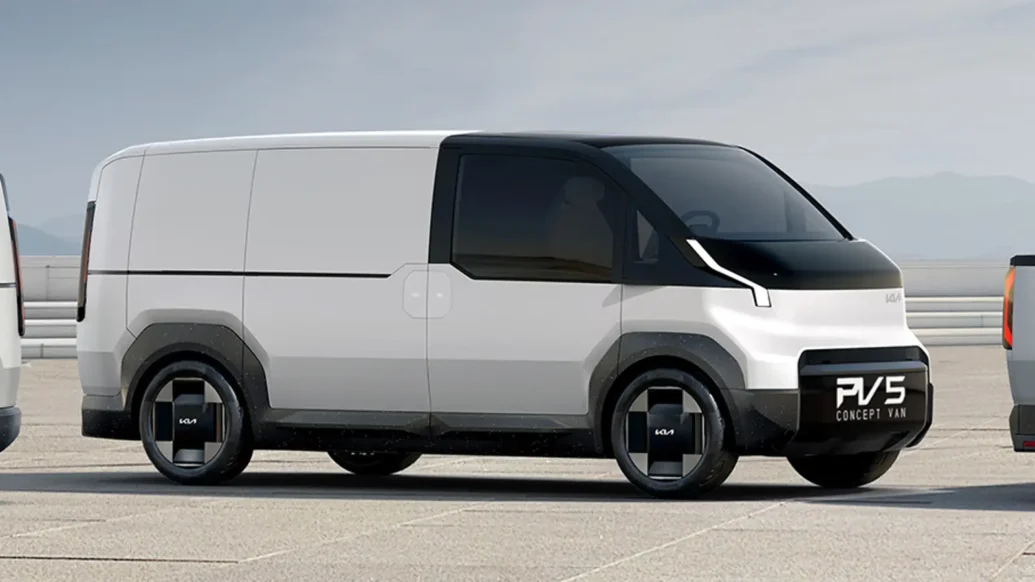
Kia’s first entry into the medium-sized van market has been previewed in Las Vegas as the Korean company shares a first look at the Kia Concept PV5 electric van.
The Ford Transit Custom-sized model is part of Kia’s planned assault on the commercial vehicle sector using its new Platform Beyond Vehicle (PBV). The PBV concept promises a ‘total mobility solution’ that starts from a simple van and extends to new business and lifestyle opportunities by, Kia says, redefining the concept of space thanks to advanced, tailored interiors that provide ultimate freedom and flexibility.

Each Kia PBV will share a broadly similar design language, reflecting the solid and robust nature required of the vehicles. Bereft of unnecessary adornments, the shapes are clean and sleek, with any features serving a purpose beyond simple aesthetics.
The basis of the van range is a modular chassis with a fixed cab. Behind that, various interchangeable upper bodies can be connected to the base vehicle via electromagnetic and mechanical coupling. It’s possible, therefore, to fit out the PBV as a multi-seater taxi during the day, switch to a panel van body at night, and even turn it into a personal recreation vehicle at the weekend, assuming there’s somewhere to hide the bodies.
The body structures will be made up of high-strength tubular steel and engineered polymers, reducing typical part counts by 55% without any loss in rigidity. Each will be shipped in a standardised, convenient kit form, allowing for the simple in-field transformation of the van.

For the users, large doors open wide to reveal a pillarless opening, making entry and exit a cinch. The extended wheelbase and flat platform — made possible by placing the battery packs in the floor of the vehicle — provide countless possibilities for cargo and passenger-carrying options.
The cabin provides a professional working area for the driver, with the dashboard forming a desk-like surface, while the steering wheel folds up out of the way and doubles as a desk lamp to create an office-like environment.
Kia’s sustainability goals will also be visible, with extensive use of materials such as bioplastic, post-consumer material plastic, bio paint, recycled PET fabric, felt and yarns, and bio-PU foam providing visual and tactile appeal.

With the vehicle being revealed at the Consumer Electronics Show , Kia is making bold claims about the in-vehicle infotainment, with the vans recognising users’ requirements in real-time and providing immediate contextual information. A PBV app marketplace is promised, with Kia and third-party apps available, although getting users to give up their Apple CarPlay or Android Auto connections and sign into another digital ecosystem will be a tough task.
“Kia PBVs will initiate a new era of seamless everyday business and lifestyle solutions,” explains Karim Habib, executive vice president and head of Kia Global Design. “We hope to make our customers’ lives easier and better, whether they’re stationary or on the move, offering exceptional flexibility and customisation through radical modularisation. Untethered to any fixed place, and unbounded by the traditional restrictions of space, Kia PBVs offer users a blank canvas to reimagine their lifestyles and workstyles.”
What Are We Actually Going To Get?
There’s no doubting Kia’s ambitions, but it will start at a realistic place. The first vehicle to arrive in the UK will be the PV5 electric van, which will come in traditional panel van form, along with high roof and chassis cab versions.

That will be followed up by two more vehicles. The PB7 will be the largest product in the lineup — broadly similar in size to a Ford Transit — and will offer more interior space, greater driving range, and enhanced functionalities.
The tiny PV1 will sit at the other end of the range, providing a vehicle suitable for last-mile deliveries and short-distance logistics transportation.

Every model will include an integrated rail system on the floor, side panels and ceiling, enabling customers to adapt and specify the vehicle as they need. It will also allow for an easy transfer of goods between vehicles, using cabinets and frames that can slide from one door to another — although that will only work from Kia to Kia, so forklift drivers need not worry yet. Buyers will also be able to specify ‘tiles’ in the back to fit out the load area as they see fit, with anything from shelves to speakers available.
The numbering of the range also leaves a gap where a PV3 could slot in, offering a Citroen Berlingo-sized version of the modular and flexible LCVs, but Kia has yet to confirm that such a vehicle will make it to production.
Future Ambitions
Things get a little more aspirational beyond the PV5 and forthcoming PV1 and PV7 vehicles. Kia says it plans to introduce a software-based PV5 Robotaxi model to provide a completely autonomous taxi service for passengers, and will work to introduce multimodal services and mobility hub businesses based on advanced air mobility — or flying cars.

The use of robot dogs from Boston Dynamics was also mentioned by Kia, to enhance ‘logistics automation and round-the-clock quality control’ at its factories, assuming we all survive to make it to that dystopian future.
Fleet Solutions
Kia will introduce a dedicated customer participation-based development process. The cooperation between brand and customer will allow for the creation of more tailored, mission-specific solutions.
With the success of the Ford Pro Liive service in every manufacturer’s sights, the integration of Fleet Management Systems and charging programmes will combine the PBV’s software-based data and AI technologies, enabling predictive and proactive maintenance and a reduction in downtime for customers.

Charging solutions will also be tied to the vehicles, optimising schedules for maximum efficiency and taking into consideration battery charge levels, routes, schedules, and breaks, ensuring charging programs are tailored to the customer’s operating environment.
Fleet managers will be able to look after multiple vehicles using software unified across all systems, with features such as inventory monitoring, temperature control, and intelligent route planning for improved efficiency, utilising real-time data and AI integration.
“The Kia PBV business is the pinnacle of our customer-centric business approach. With the aim of developing PBVs and solutions tailored to their business environments, we are confident that these strong partnerships will be a driving force on the road to becoming a sustainable mobility solutions provider,” said Pierre-Martin Bos, Vice President and BDM Director of Kia PBV Business Division.
Kia PV5 Van Pricing and Availability
We’re a long way from the Kia PBV range reaching UK shores. The factory in South Korea will reach full production in 2025, with the capability of producing up to 150,000 vehicles a year.

The first vehicle, the Kia PV5 van, is expected in the UK in the first half of 2025. There’s no pricing information, or even reliable technical data about battery size and range. Still, taking a guess based on current market pricing, we’d expect a figure of around £40,000 plus VAT.

- Mitsubishi L200 Commercial swaps rear seats for van tax treatment - 10 September 2026
- Volkswagen launches blacked-out Amarok Dark Label pickup - 9 September 2026
- Pickup market plunges to lowest level since Covid lockdown - 8 September 2026