Mercedes-Benz is changing the way it makes vans, and it’s more significant than you might think. Starting in 2026, all new vans from Mercedes will be based on just one modular and scalable platform. Called VAN.EA — short for Van Electric Architecture — it’s been developed from scratch to support battery electric LCVs.
Encapsulating Mercedes’ “electric-only” strategy, all future midsize and large vans will be built on it, both commercial and private. This move isn’t just about moving towards cleaner energy; Mercedes also aims to provide added value to its customers by catering to their individual needs.
“This enables us to consolidate our midsize and large vans down to only one architecture and significantly reduce the complexity of our product portfolio,” explains Mathias Geisen, Head of Mercedes-Benz Vans. “[Providing] maximum added value for customers with sustainable profitability at the same time, Van.EA clearly underscores our aspiration to ‘Lead in Electric’.”

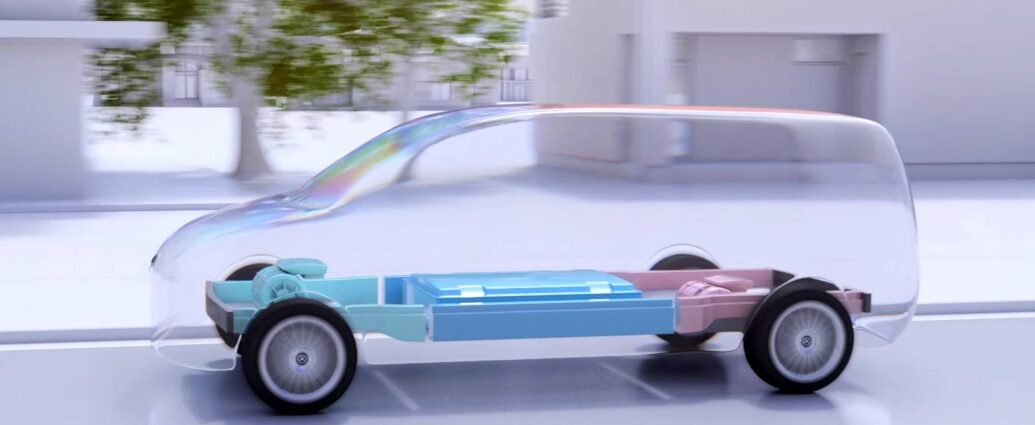
The Mercedes Van.EA platform focuses on efficiency and performance, including aerodynamics, drivetrain, tyres, and chassis, to achieve a high electric range with optimal battery capacity. Built in three modules — front, centre, and rear — each has been designed to offer an optimised common parts strategy, with a scalable vehicle length and a choice between front-wheel and all-wheel-drive variants. The architecture also accommodates different battery capacities, addressing different customer requirements.
The front module consists of the electric powertrain and front axle and will be the same in all Mercedes Van.EA variants. The differentiation between configurations takes place in the two other modules; the centre module is where the battery packs are stored and scales the vehicle length. The rear module will be available in two versions — with an electric motor for all-wheel-drive variants, or without a second motor for front-wheel-drive models.
The new platform forms the ideal base for customers who value functionality, reach, payload and cargo space, says Mercedes. With a modular and scalable design, the architecture is tailor-made for different configurations and upfitter solutions: From courier, express, and parcel delivery vehicles to ambulances or grocery vans, from municipal vans or flatbeds to lifting platforms or recreational vehicles, almost everything is possible.
At launch, autonomous driving to level 2 — mostly automatic, but you still need to be paying attention and take over when necessary — will be available, with an expectation that level 4 autonomy — full self-driving without human input, although you’ll be able to take over and drive manually if needed — will be offered by the end of the decade. This opens the door for driverless operations.
Mercedes also aims to decrease CO₂ emissions across the lifecycle of new vans significantly, with a target of over 50% of its LCV sales being electric by 2030.
The company eyes substantial growth in its most important markets, including Europe, the US, and China. In the US, it aims to increase sales profitably substantially by 2030 and expand the portfolio by adding Van.EA-based commercial vans to its lineup.
The worldwide courier, express, and parcel services market, with an annual growth of 6‑8% per year, is a strong driver for fully-electric urban mobility. Mercedes focuses on the upper price bands of the CEP industry, where it intends to offer a Van.EA CEP-specific version for the first time.
As part of its global expansion, Mercedes is reorganising its production network, with its first pure electric light commercial vehicles (eLCV) plant in Jawor, Poland. This plant is expected to set new standards in productivity, lean operations, and sustainability for manufacturing premium eLCVs. The manufacturer plans to cover 100% of its energy needs through renewable sources, including photovoltaics, wind power, geothermal, and solar thermal energy.
- Ford Ranger PHEV onboard power is cleaner and cheaper than a generator
- Pickup market slumps for ninth straight month after tax changes
- Ineos Grenadier and Quartermaster cleared for UK blue-light use

- JAC Hunter PHEV points to faster-moving electrified pickup market
- Urban builds the Defender pickup Land Rover won’t sell